


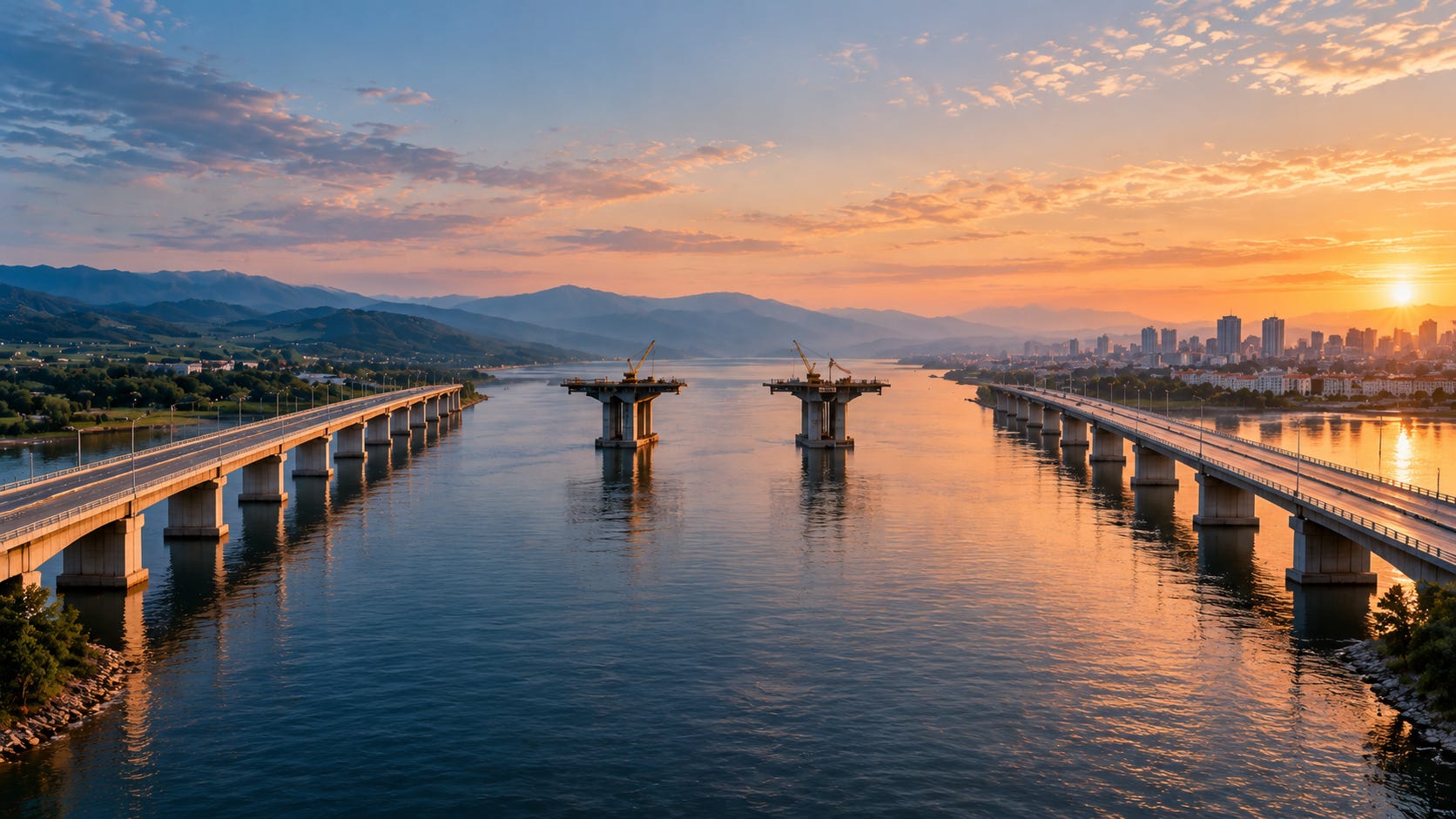
Within the span of two months, North Korea has inaugurated two new road crossings on its northern frontier, the first linking it to Russia across the Tumen River and the second connecting it to China across the Yalu.
The bridges can be understood as complementary instruments through which North Korea seeks to advance its economic, military and political objectives simultaneously. They illustrate how much ground Pyongyang has gained in recent years, yet they also expose the extent to which its gains continue to rest on external foundations it does not control.
The Russian bridge, formally opened on September 7 at a ceremony attended by senior officials from both countries, was built with remarkable speed, given that the two sides only agreed to the project during Vladimir Putin’s visit to Pyongyang in June 2024 and that construction began less than a year later.
Linking Rason with the Russian border settlement of Khasan, it is the first dedicated road crossing between the two countries, and while much attention has understandably focused on its potential role in facilitating the transfer of munitions and personnel in support of Russia’s war in Ukraine, its significance is likely to outlast the current conflict.
While trade between Moscow and Pyongyang is unlikely to approach the scale of North Korea’s economic relationship with China, a permanent road connection could nevertheless prove valuable for specialized forms of exchange, including tourism, labor mobility and the discreet movement of sensitive military materials, thereby further anchoring the relationship.
Last week’s opening of the New Yalu River Bridge, the second crossing connecting the Chinese city of Dandong with the North Korean provincial city of Sinuiju, carries a different but equally important set of meanings. The four-lane structure, now the largest border crossing between the two countries, had remained unused for more than a decade after its completion, in part because Pyongyang appears to have feared that it would deepen its economic dependence on China, and analysts have suggested that North Korea may have sought concessions facilitating exports and expanding opportunities for its workers in China before agreeing to open it.
The timing of the opening, which coincided with the commemoration of China’s entry into the Korean War, allowed both sides to frame the bridge as a symbol of a friendship that, in the words of North Korean state media, has “persevered its nature despite the trials of history.”
Kim’s decision to attend in person despite Xi Jinping’s absence also indicates that Pyongyang regards the project as significant enough to warrant the leader’s presence, and the attendance of Wang Huning, the fourth-ranking official in the Chinese Communist Party, alongside Wang Yi and other senior figures, suggests that Beijing did not intend Xi’s absence as a snub. Rather, the event appears to reaffirm the commitment to deeper ties that Kim and Xi agreed upon in June, signaling that North Korea is no longer keeping Beijing at arm’s length as it did in recent years.
This rapprochement rests on a solid economic foundation, since official trade between the two countries reached USD $1.5 billion in the first half of this year according to Chinese data, its highest level since comprehensive UN sanctions were fully implemented in 2017, while the opening of the bridge and Kim’s inspection of a bus plant in Dandong point to the possibility of further loosening in China’s sanctions enforcement.
Nevertheless, the Yalu bridge should not be interpreted as a competitor to the Tumen crossing, because the two relationships serve different purposes, with ties to Moscow being predominantly military in character and those with Beijing centered on trade and more conventional economic relations. It is arguably the latter that will prove more consequential in the long term, given that Russian support hinges heavily on Putin and the war in Ukraine, whereas Chinese support is grounded more in decades of shared history, the mutual defense treaty that remains Beijing’s only formal alliance, and China’s overarching priority in preventing instability on its border.
Taken together, the two bridges represent meaningful interim gains for Pyongyang, as they weaken the practical effect of sanctions, reinforce the image of North Korea as a “normal” country with ordinary trading ties, strengthen Kim’s standing as a leader backed by powerful partners, and increase the leverage North Korea can bring to bear on Washington.
Yet these gains come at the cost of deepening the very dependence that Pyongyang has long sought to avoid, reproducing a Cold War pattern in which the country remained diplomatically and economically reliant on Moscow and Beijing.
For the moment, the bridges depict a North Korea that is better positioned than it was a few years ago but not necessarily more resilient, pursuing a high-risk, high-reward strategy whose sustainability remains doubtful.
The question, therefore, is whether Kim can convert these short-term advantages into lasting internal resilience by investing in sectors such as education, healthcare, manufacturing and the defense industry. For the moment, the bridges depict a North Korea that is better positioned than it was a few years ago but not necessarily more resilient, pursuing a high-risk, high-reward strategy whose sustainability remains doubtful.
Moreover, neither of these bridges will allow Pyongyang to achieve its most fundamental objectives, since the lifting of sanctions, a formal end to the Korean War and the ability to function on the world stage as a quasi-normal state all depend on a far more difficult bridge to build: namely, one with the United States.
As long as diplomacy with Washington remains stalemated, it matters little how many bridges the DPRK builds to China or Russia, since the only actor that can give Pyongyang what it wants the most remains the United States.
While there has been speculation about a possible meeting between Trump and Kim on the sidelines of the upcoming APEC Summit in China, there are no clear signs yet pointing to any concrete plans.
Having the strong backing of Moscow and Beijing may place Kim in a stronger position compared to Hanoi in 2019, but a relatively stronger position in and of itself does not translate into greater influence over adversaries.
The real test of Kim’s statecraft will therefore lie not in his ability to build bridges with his closest allies, but in whether he can construct, and sustain, one with Washington that is capable of bridging the two sides’ security concerns, competing aspirations and the compromises that any durable settlement will require.