


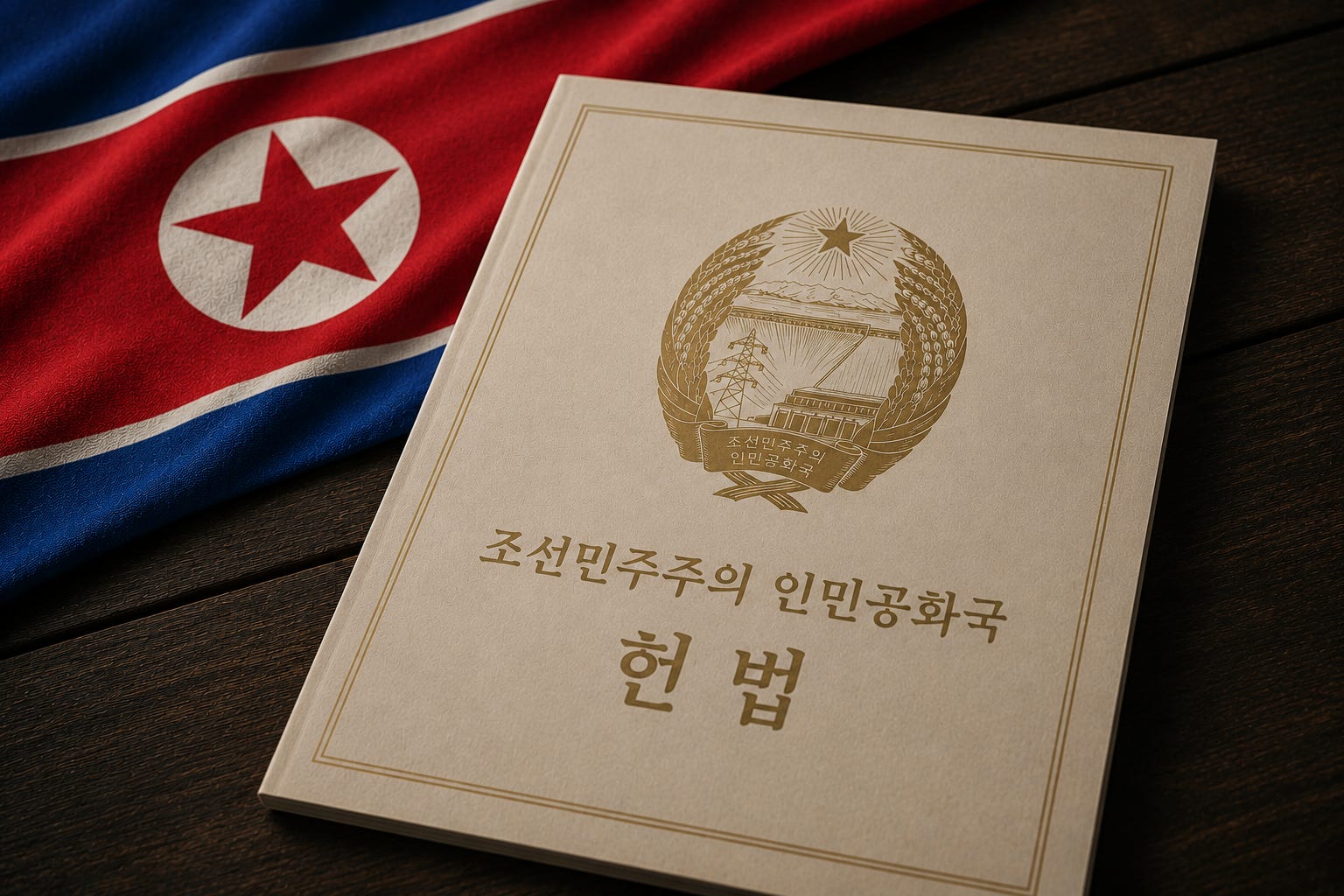
In March 2026, North Korea made one of the most consequential legal changes in its modern history. The latest constitutional revision, which removed all references to unification and introduced the country’s first explicit territorial clause, marked the formal legal completion of a strategic reorientation that Kim Jong Un had been signaling since 2023.
The revised document, now referred to simply as the “Constitution” instead of the “Socialist Constitution”, notably refrained from labeling the ROK a “hostile" state,” despite increasingly aggressive rhetoric from Pyongyang toward Seoul in recent years.
The implications for inter-Korean relations deserve deeper analysis, as do the questions the DPRK legal revisions raise for Seoul’s own unification policy.
What Changed, and What It Signals
The most significant change in the revised constitution is the introduction of an explicit territorial definition. Article 2 now states: “The territory of the Democratic People’s Republic of Korea is defined as the land bordering the People’s Republic of China and the Russian Federation to the north, and the Republic of Korea to the south, including the territorial waters and airspace established on this basis.” The ROK is named, and implicitly recognized, as a neighboring sovereign state rather than a breakaway region or target of reunification.
By specifying its boundaries in relation to the ROK by name, Pyongyang has formalized what had previously been a rhetorical and institutional shift into its foundational legal document. The removal of unification language and the absence of hostile characterizations of the South together suggest a deliberate move toward a legal framework premised on two-state coexistence rather than peninsular unification under any one political system.
The ROK’s National Intelligence Service (NIS) assessed the revision as clearly defining the two Koreas while significantly reducing hostility toward the South, noting that the emphasis was on maintaining the status quo and managing the situation rather than adopting an offensive posture.
Nevertheless, while the revised constitution does not label the ROK as “hostile”, this does not mean the DPRK will significantly shift its position toward Seoul any time soon. Pyongyang has little immediate incentive to pursue engagement with the South. Its near-term focus remains on extracting concessions from Washington— particularly recognition as a nuclear state— while managing its strategic partnerships with Beijing and Moscow.
The constitutional shift should thus not be read as an imminent diplomatic opening for the ROK, but can be interpreted as setting a foundation from which bilateral relations between two sovereign states can be developed in a more sustainable and long term way.
The Case for and Against Abandoning Unification
The revised DPRK constitution sharpens a question that has been building in Seoul for some time: should the ROK continue to pursue unification as a national goal, or is (peaceful) coexistence a more viable and less dangerous alternative?
The case for maintaining unification as policy rests on principle as much as existing legal frameworks. First, the goal of unification continues to be enshrined in the ROK constitution, making it the legal responsibility of each administration to pursue this goal.
Beyond the legal obligation, North Korea remains one of the world’s most repressive states, and critics of any policy pivot argue that abandoning unification effectively ratifies the DPRK’s authoritarian rule and the ongoing deprivation of rights for its people. This is not a trivial concern and any sober analysis of ROK policy must acknowledge that the question of what a coexistence framework means for the 25 million people living under the Kim regime cannot be resolved by simply reframing the diplomatic objective.
At the same time, the path to unification as currently configured carries serious costs. The German precedent, often invoked in comparison to the Korean case, was possible because one system collapsed, allowing reunification under the surviving framework. Replicating that model on the Peninsula would require either the internal collapse of the DPRK leadership or a military conflict.
The former appears unlikely in any near-term timeframe; the latter would be catastrophic. It is also worth noting that the Korean division has lasted significantly longer than Germany's, and that over seven decades of separation have produced two societies, political cultures, and economic systems that are far more divergent than those of East and West Germany at the time of reunification. The presence of a developed nuclear arsenal in the DPRK further adds a variable that has no German analogue. It therefore goes without saying that the DPRK's leadership will not willingly cede political control, sovereignty, or territory in exchange for unification under a democratic-capitalist system.
Related to this point, remarks by the current ROK Unification Minister referring to unification as a “violent” process and an “idealistic concept” have drawn significant criticism. Further controversy arose with the Minister’s calls for the “institutionalization of peace” in place of unification and for referring to North Korea by its official name— both departures from decades of established ROK policy.
While the latter could be seen as a concession to the DPRK, it could also be interpreted as a step toward tilting the ROK’s DPRK policy toward the goal of peaceful coexistence, which the current Lee administration has consistently been advocating for.
A Foundation for Coexistence?
Seoul’s response to the DPRK constitutional revision has been to reaffirm its commitment to peaceful coexistence rather than contesting the two-state framing. Still, unification remains the ROK’s official goal and Article 3 of the ROK constitution continues to claim sovereignty over the entire Korean Peninsula.
While a constitutional amendment in the South equivalent in scope to what Pyongyang has just done would be a profound move in terms of assuring the DPRK any form of unification by absorption is legally off the table, such a revision remains a politically contentious undertaking that is unlikely to materialize in the near term. The growing gap between the two states’ legal frameworks, and the political difficulty of closing it on the ROK side, will remain a constraint on how far coexistence policy can formally advance.
Incremental steps are nonetheless possible and meaningful. Referring to North Korea by its official name and reframing peninsula policy around improving ties between two sovereign states rather than pursuing unification could represent small but meaningful steps toward setting a foundation for stable, and ultimately peaceful, coexistence between the two Koreas.
Whether Seoul decides to move deliberately in that direction will be one of the defining policy questions of the Lee administration. The DPRK’s constitutional revision and the ROK’s tentative rhetorical shift toward coexistence suggest that both sides are edging, however unevenly, toward a structurally similar framework.
The 1991 simultaneous entry of both Koreas into the United Nations established their de-facto recognition as separate states before much of the international community; what 2026 may represent is the belated formalization of that reality within the peninsula’s own legal architecture, at least on one side of the 38th parallel.