


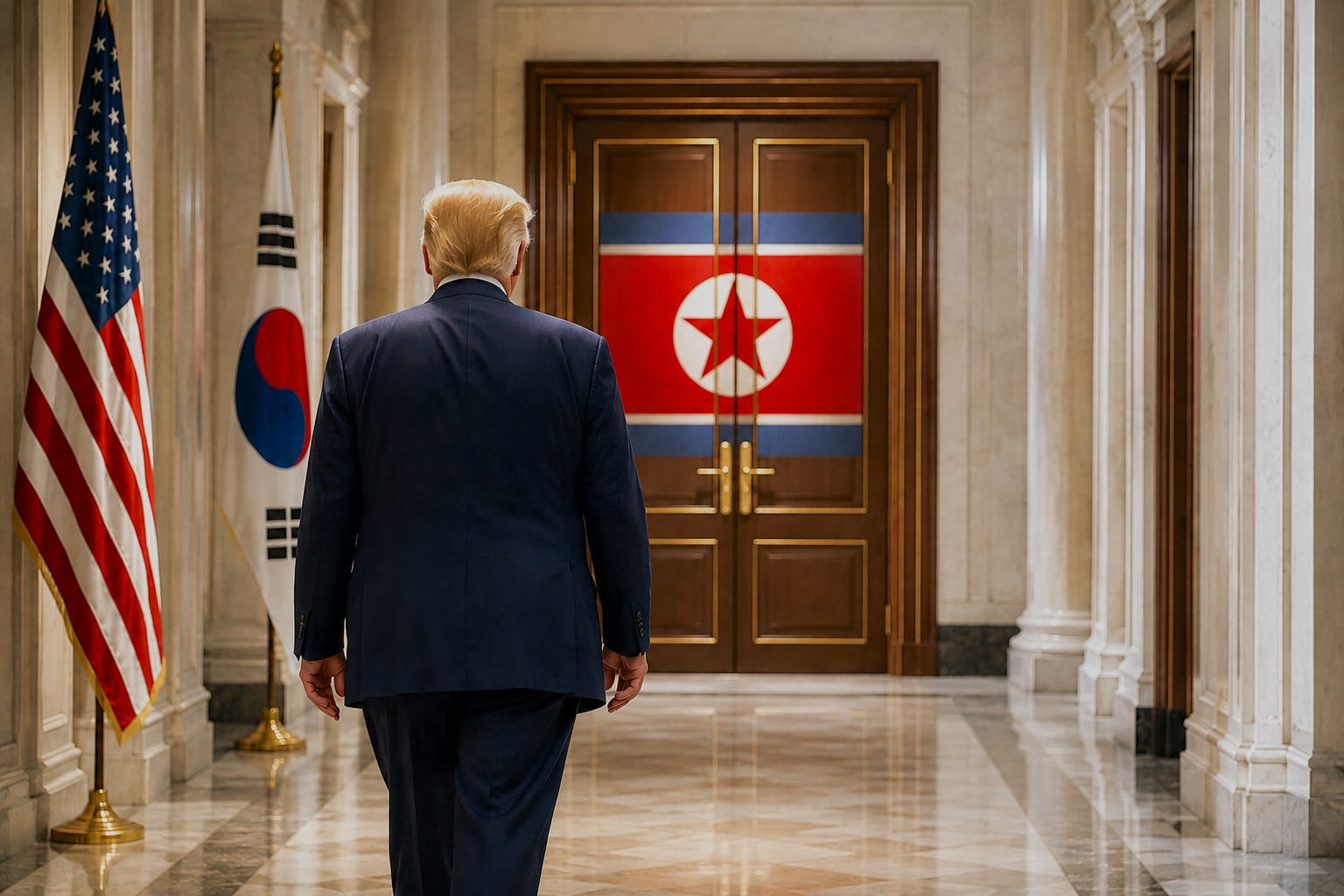
President Trump’s abrupt order to cut the Ulchi Freedom Shield drills from eleven days to five has forced South Korea to confront an increasingly critical question: what does its security look like when Washington’s commitment can shift without warning?
In a social media post on Monday, Trump stated that he was “not happy with the fact that the United States has, long ago, agreed to participate in Joint Military Exercises with South Korea.” He called the drills “totally inappropriate and hostile” toward Pyongyang, and folded in an unrelated grievance over Seoul’s refusal to join the American military campaign against Iran.
The deeper lesson is not that the alliance is collapsing, but that South Korea’s long-term security cannot be fully outsourced to any single partner—even one bound by a mutual defense treaty and seventy years of alliance.
Full decoupling from Washington remains neither feasible nor desirable in the near term. The extended deterrence umbrella, roughly 28,500 US troops stationed on the peninsula, and an integrated command structure are capabilities Seoul cannot replicate quickly or cheaply. Still, the messaging coming from Washington is cause for concern in Seoul.
President Lee Jae-myung’s response, however, points in the right direction: he reaffirmed his commitment to reclaiming wartime operational control (OPCON) by the end of his term and called for strengthening overall independent defense capabilities, framing stronger South Korean capabilities as what makes the country a more valuable ally, not a less dependent one.
This should be understood as an opportunity as much as a disruption. A South Korea that invests more seriously in independent capabilities, an indigenous defense industry, and a wartime command structure under its own generals is not abandoning the alliance. It is strengthening its position within it—while creating greater latitude to diversify its security relationships beyond a single guarantor.
Deeper defense-industrial ties with Europe, closer trilateral coordination with Japan on missile defense and intelligence sharing, and a more assertive South Korean voice in shaping Washington’s regional posture around ROK interests all become more urgent when the ally demonstrates how quickly its policies can change. None of this requires weakening the relationship with the US. It is, however, necessary to acknowledge that the alliance is no longer sufficient to guarantee ROK security.
This week’s diplomacy in Seoul underscored the same vulnerability from another direction. ROK Foreign Minister Cho pressed Wang Yi for Beijing’s support in facilitating dialogue with Pyongyang, but emerged with little more than a general pledge to play a “constructive role.” That outcome reflects a structural constraint and not a diplomatic shortfall, since China has its own strategic stakes in shaping any US-DPRK opening.
Beijing’s courting of Kim Jong Un and provision of economic lifelines that dilute sanctions pressure serve Xi’s broader strategic interests, which do not necessarily align with Seoul’s. Treating Beijing as a neutral broker therefore risks outsourcing South Korea’s diplomacy to a power pursuing its own agenda.
This underscores how Seoul needs independent channels of influence with both Washington and Pyongyang, rather than relying on access mediated by great powers whose strategic priorities may diverge from its own.
Beyond these challenges, the drill reduction also should not be separated from what Trump is signaling toward Pyongyang, which could be cause for (cautious) optimism.
Regardless of Trump’s controversial style of conducting diplomacy, he remains the only sitting American president to have met a North Korean leader in person on multiple occasions. Kim Yo Jong’s statement on Wednesday denying any communication with Washington and dismissing the drill reduction as insufficient should not be mistaken for a closed door.
Pyongyang’s core objectives have remained remarkably consistent for decades: normalized relations with the United States, sanctions relief, and a peace mechanism that reduces what it perceives as the US security threat.
If Trump is willing to decouple future talks from a rigid denuclearization precondition, even preliminary or working-level engagement becomes plausible. This, in turn, has value for Seoul regardless of how the alliance friction develops. A resumption of US-DPRK dialogue, however limited, could eventually reopen space for inter-Korean channels that have remained dormant for years.
Notably, the Wall Street Journal reported in an exclusive on Tuesday that Trump is pushing for a meeting with Kim as soon as November, which is when the US leader is scheduled to visit the region for the APEC summit in China. The next day, Trump further added to the speculation by responding to a question about his expectations for a summit with Kim by answering, “Yeah, I will be [meeting Kim].”
The window for this kind of engagement is narrowing given that Trump’s remaining years in office are finite, and there is no guarantee that his successor will share the same willingness to pursue diplomacy with Pyongyang at the level he has demonstrated.
If Seoul wants Washington’s engagement with Pyongyang to advance South Korean interests rather than simply American ones, the coming months matter more than the drill schedule itself.
South Korean policy therefore has to hold two truths simultaneously: accelerate the development of independent military capabilities and diversified defense partnerships that reduce its exposure to the next unilateral decision from Washington, while actively supporting and guiding whatever opening emerges between Trump and Kim before that window closes.
Interesting 🤔 Politics makes strange bedfellows: carpe diem!