


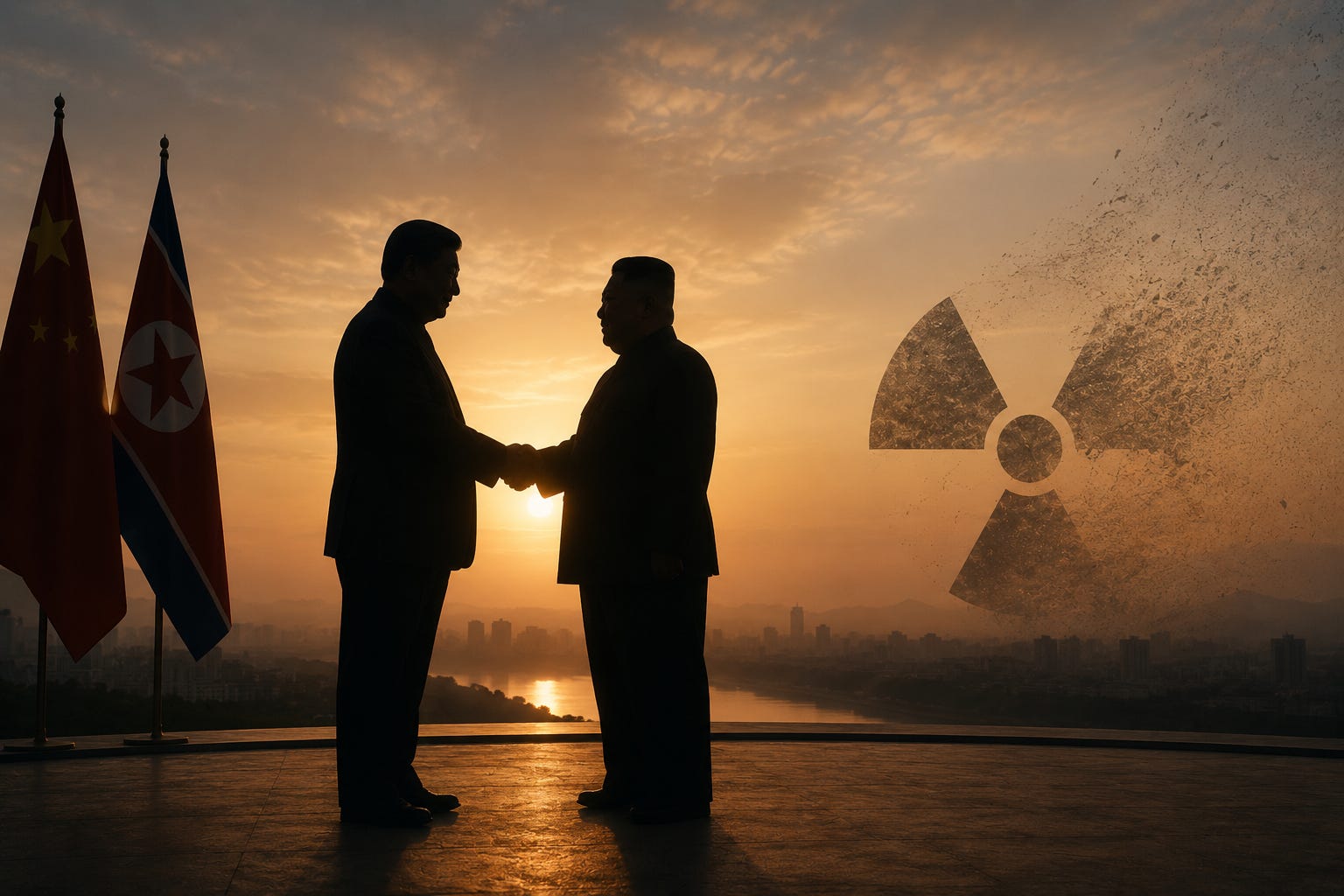
Chinese President Xi Jinping’s visit to North Korea this week has reinforced a reality that has been gradually emerging for several years: the goal of denuclearizing North Korea appears increasingly elusive.
The prospect of denuclearization was already facing significant obstacles following the collapse of U.S.-DPRK diplomacy at the Hanoi Summit in 2019 and the gradual weakening of the international sanctions regime. Yet Xi’s visit appears to have pushed the needle further toward de facto acceptance of North Korea as a nuclear state. While neither Beijing nor Pyongyang formally declared such a position, the symbolism, priorities, and omissions surrounding the summit are difficult to ignore.
Throughout the visit, Xi Jinping and Kim Jong Un discussed cooperation across a broad range of areas, including trade, agriculture, science and technology, public health, and construction. The two leaders agreed to strengthen communication through more frequent high-level exchanges and pledged to jointly defend the “sovereignty, security, development and interests” of their respective countries.
Kim described relations with China as North Korea’s “most important strategic priority,” while Xi called for deeper cooperation in diplomacy, law enforcement, and the military, alongside expanded practical cooperation in economic and technological fields. In practical terms, the summit is likely to result in increased economic exchanges, more frequent delegation visits, and potentially an easing of tourism restrictions for Chinese visitors.
What stood out most, however, was not what was discussed, but what was not.
Despite North Korea’s nuclear program remaining one of the most consequential security issues in Northeast Asia, neither side publicly addressed it. There was no mention of denuclearization in summit statements, no indication that Beijing raised the issue during discussions, and no visible effort by China to pressure Pyongyang on its nuclear ambitions.
Taken together, China’s decision not to discuss the nuclear issue, Xi’s choice of North Korea as his first foreign destination of the year, and the inclusion of Chinese Defense Minister Dong Jun in the delegation—unlike Xi’s previous visit to Pyongyang in 2019—suggest that Beijing is increasingly prepared to accept North Korea’s nuclear status as a practical reality.
The summit also hints at a greater willingness to expand military cooperation with Pyongyang, potentially as part of a broader effort to offset Moscow’s growing influence over North Korean defense affairs. The ROK Ministry of Unification was quick to point out Xi’s call for greater military cooperation with the DPRK, stating “it was the first known case in which the subject has been raised publicly.”
While the summit was bilateral in nature, its implications extend far beyond China and North Korea, affecting the strategic calculations of the United States, South Korea, and Japan.
Implications for the United States
For Washington, the visit presents a particularly uncomfortable challenge. Officially, the United States remains committed to the complete denuclearization of North Korea. Following the recent Trump-Xi summit in Beijing, the U.S. State Department pointed to both leaders having reaffirmed denuclearization as a shared objective.
Yet Xi’s silence on the issue in Pyongyang sends a different signal. While China has stopped short of explicitly recognizing North Korea as a nuclear power in the way Russia has done, Beijing’s actions suggest that it is no longer willing to expend significant diplomatic capital attempting to reverse Pyongyang’s nuclear advances. In effect, Xi appears to have communicated that China will not be pushing Kim Jong Un toward denuclearization.
This matters because Kim has repeatedly stated that dialogue with the United States can only resume if Washington recognizes North Korea as a nuclear state. With Russia already acknowledging the DPRK’s nuclear status and China increasingly behaving as though it accepts it, pressure is gradually building on the United States to reconsider its own approach.
At present, Kim appears in no hurry to return to negotiations. Strong political, economic, and diplomatic support from both China and Russia has significantly reduced the urgency for Pyongyang to engage with Washington.
Time increasingly favors North Korea rather than the United States and its allies.
The longer diplomacy remains stalled, the more opportunities Pyongyang has to expand military cooperation with external partners and continue modernizing both its conventional and nuclear capabilities.
The key question now is whether President Donald Trump will eventually pursue what Xi appears to have adopted: a policy of silent de-facto acceptance, e.g. by proposing talks that are not centered on denuclearization. Such a shift would represent one of the most significant changes in U.S. policy toward North Korea in decades.
Implications for the ROK
For South Korea, the Xi-Kim summit arguably leaves Seoul in a weaker position than before.
Not only does Pyongyang continue to reject communication with the South, but Kim has now publicly reaffirmed that relations with China constitute his government’s foremost “strategic priority”. Combined with North Korea’s deepening ties with Russia, this suggests that Kim’s diplomatic attention will remain focused on Beijing and Moscow, leaving little room for engagement with the administration of President Lee Jae-myung.
The Lee government has sought to reorient South Korea’s North Korea policy away from the long-term objective of unification—which Kim formally abandoned in 2023—and toward the more modest goal of peaceful coexistence. Nevertheless, Seoul continues to insist on denuclearization as an essential objective. From Pyongyang’s perspective, that position remains incompatible with meaningful dialogue.
Seoul’s position remains the same after the summit, with South Korean Foreign Ministry Spokesperson Park Il reaffirming on Tuesday that “our government will continue to uphold the goal of denuclearizing the Korean Peninsula without wavering.” The Ministry likewise emphasized that the United States and China had recently reaffirmed denuclearization as a shared objective.
At the same time, South Korean officials paid close attention to Xi’s call for expanded military cooperation with North Korea, with the Unification Ministry also highlighting the significance of Defense Minister Dong Jun accompanying Xi during this trip.
Although Beijing is unlikely to provide military assistance on the scale currently associated with Russia’s cooperation with Pyongyang, China may increasingly see a need to strengthen defense ties with North Korea. From Beijing’s perspective, allowing Russia to become North Korea’s dominant military partner could reduce Chinese influence over developments on the peninsula and contribute to greater regional instability. None of this bodes well for Seoul.
Implications for Japan
Japan is also unlikely to view the summit positively.
Like South Korea, Tokyo remains largely excluded from contemporary diplomatic processes involving North Korea. Pyongyang has rejected Japanese proposals for talks and has increasingly aligned itself with Beijing in criticizing what it describes as growing Japanese militarism.
Japan continues to support the denuclearization of North Korea and is unlikely to abandon that position in the foreseeable future, even if Washington eventually modifies its own negotiating framework. As a result, Tokyo could find itself increasingly isolated should major powers begin moving toward a more pragmatic acceptance of North Korea’s nuclear status.
Toward a new status quo?
The Xi-Kim summit ultimately represents a significant diplomatic success for both Beijing and Pyongyang.
For China, Xi’s decision to visit North Korea in person—particularly as his first foreign trip of the year—helps restore and reinforce Beijing’s influence in Pyongyang at a time when Russia’s role has expanded dramatically. Kim publicly reaffirmed support for the One China Principle, while Xi endorsed expanded cooperation across multiple sectors, including diplomacy, the economy, law enforcement, and,—most notably—military affairs.
Most importantly, however, the summit occurred without any mention of denuclearization. For Kim Jong Un, that omission may represent the greatest victory of all. The visit strengthened North Korea’s diplomatic position, expanded its economic opportunities, and increased its leverage vis-à-vis the United States and its allies.
What happens next may prove decisive. Kim will almost certainly be watching closely for signs of a shift in Washington’s approach following Xi’s visit. Should the United States move toward its own form of de facto recognition of North Korea’s nuclear status, Seoul and Tokyo would face difficult strategic questions about how to reconcile their long-standing denuclearization policies with a changing international environment.
At the same time, there is no guarantee that a shift toward de facto acceptance would produce a successful arms control agreement. Moreover, if future U.S. administrations later reverse course, the result could simply be another cycle of failed diplomacy, renewed tensions, North Korean military expansion, and regional instability.
For now, Xi’s visit does not mark the formal death of denuclearization. It does, however, underscore how far the goal has receded from practical reality.
Great piece. And sadly I tend to agree with this sentiment, I think that denuclearization is a dead letter. Kim can now bounce between Russia and China for support.
Gabriela, this is a sharp reading of what the summit deliberately omitted. I wonder, however, whether denuclearization is dead—or whether it has changed function.
As a near-term operational objective, it may indeed be exhausted. But as a legal and normative objective, it remains indispensable. Abandoning it would not merely acknowledge an existing capability; it would begin converting factual possession into legitimate nuclear status, with consequences for the NPT regime and for proliferation incentives in South Korea and Japan.
Beijing’s silence may therefore represent strategic accommodation without legal recognition: accepting North Korea’s nuclear capability as an operational reality while continuing to deny it formal legitimacy. This suggests a distinction between capability, de facto acceptance, and de jure recognition—three levels that are often collapsed into one.
The emerging policy may not be denuclearization or recognition, but deterrence, risk reduction, and limited arms control without legitimization. Time may favor North Korea’s arsenal, but not necessarily the strategic environment forming around it.