


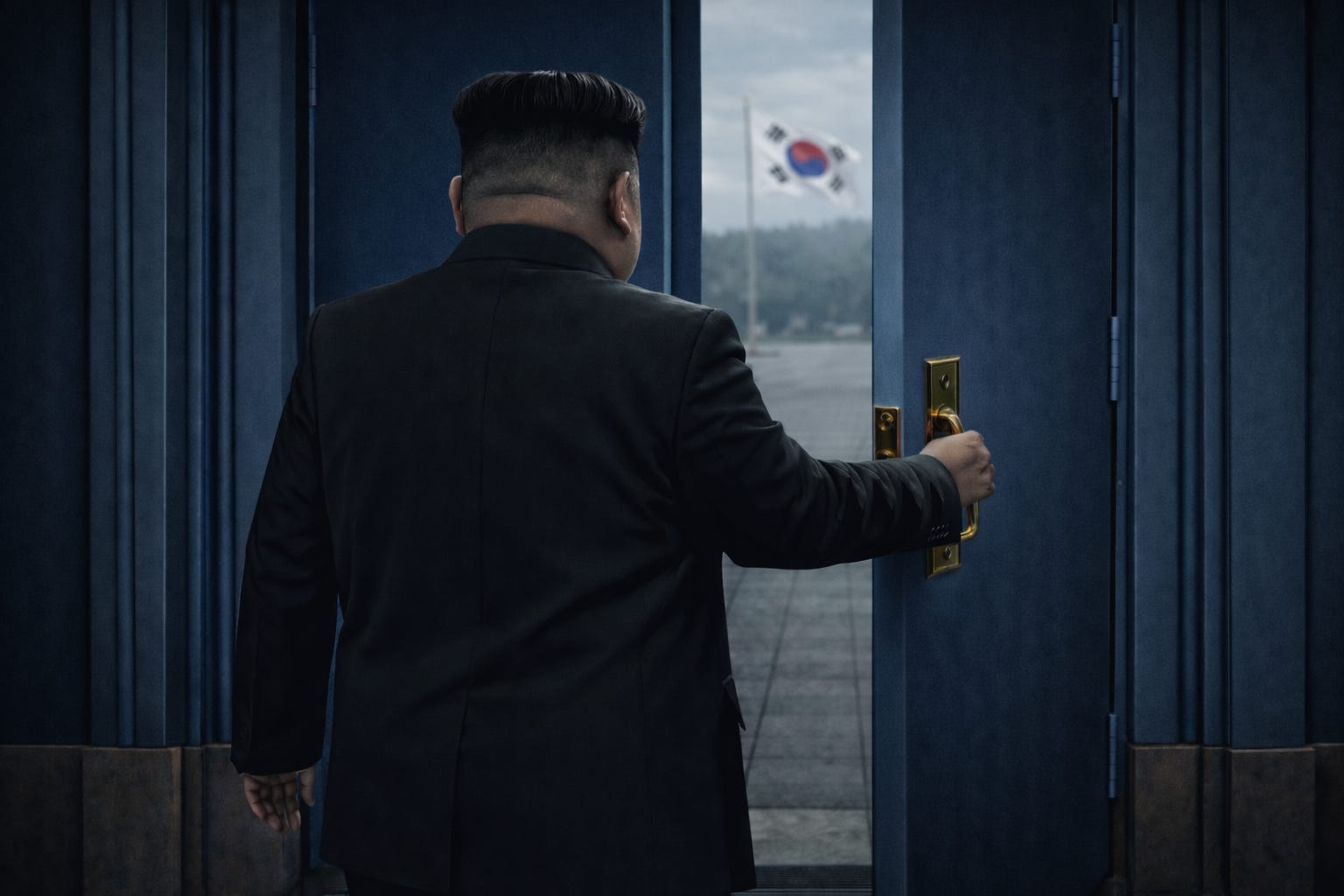
The Ninth Congress of the Workers’ Party of Korea (WPK), held from Feb. 19-25, has produced the most explicit articulation to date of North Korea’s position toward South Korea.
Speaking at the Congress, Kim Jong Un declared that the DPRK “has nothing to discuss with the ROK, the most hostile entity, and will exclude the ROK from the category of compatriots forever.” He further stated that the shift in policy is “not a temporary tactical measure but a historic option for defending our national interests and national prestige,” adding that unification is “utterly impossible.”
“Our position on the ROK is clear. We clarify once again through the Party Congress, the supreme leadership body of the ruling party which sets forth the lines and policies of the state. The DPRK has nothing to discuss with the ROK, the most hostile entity, and will exclude the ROK from the category of compatriots forever. We will perpetuate the present situation, in which the conditions of contact with the ROK have been completely eliminated. And we will not revive the misguided past in any case.” — Report on the Ninth Party Congress, Feb. 26, 2026 (KCNA).
The significance of these remarks stems not so much from their tone, which has been following an increasingly recognizable pattern since 2020, but from the context in which they were made. A party congress is the DPRK’s highest decision-making body and is intended to establish policy lines for the coming five-year period.
Although North Korea had pointed to a constitutional amendment in 2024 designating the ROK as a “hostile state,” details remain elusive. But if any ambiguity surrounding the North’s true position toward the South remained before, it has now been dispelled. The language Kim Jong Un chose at the Congress is the clearest signal yet that the breakdown in inter-Korean relations is not a temporary condition.
North Korea is no longer presenting hostility toward Seoul as contingent on policy disagreements or reversible under improved conditions. Instead, it is consolidating a two-state framework at the level of party and state strategy.
The language used at the Congress suggests that the DPRK seeks to reduce ambiguity about its long-term posture and align its political doctrine with what it views as the enduring realities of the security environment.
The report reinforced this posture by citing recent South Korean drone incursions as evidence that the ROK “is not a neighbor which can be trusted and can co-exist.” Despite the current Lee Jae-myung administration’s efforts at engagement, the South Korean president’s overtures were dismissed as “a clumsy deceptive farce.”
Taken together, the statements suggest that Pyongyang is codifying a sustained hostile two-state framework and intends to anchor its inter-Korean policy in long-term separation rather than short-term tactical adjustment.
Drivers of Strategic Consolidation
The Congress marks the culmination of a reassessment that has likely been underway since the collapse of the 2019 Hanoi summit between Kim Jong Un and then-U.S. President Donald Trump. That episode appears to have reinforced Pyongyang’s conclusion that Seoul lacks meaningful influence over Washington’s negotiating positions and cannot function as an effective intermediary capable of securing terms favorable to the North in negotiations with the United States.
During the 2018–2019 diplomatic window, South Korea positioned itself as a facilitator between Washington and Pyongyang. The breakdown at Hanoi, however, exposed the limits of that mediation. From the DPRK’s perspective, engagement with Seoul did not translate into flexibility on sanctions relief or adjustments to U.S. denuclearization demands.
Subsequent developments have reinforced this trajectory of a breakdown in inter-Korean relations. In 2020, North Korea demolished the inter-Korean liaison office in Kaesong. In 2023, Kim Jong Un announced the abandonment of the decades-long goal of reunification. Other incidents—including balloon campaigns, growing North Korea-Russia military cooperation, U.S.-ROK joint military exercises, ROK military policy, and drone incursions— further strained relations.
North Korea’s evolving external environment has also reduced incentives for accommodation. Continued advances in nuclear and missile capabilities have strengthened its deterrent posture. Expanded military and economic cooperation with Russia, particularly since 2022, has diversified Pyongyang’s external partnerships.
From Pyongyang’s vantage point, these developments increase strategic autonomy. If the leadership assesses that it can secure economic assistance, diplomatic space, and security gains through channels other than Seoul, the rationale for inter-Korean engagement diminishes. The Congress language reflects a judgment that South Korea does not offer unique leverage or indispensable benefits.
The consolidation of a hostile two-state doctrine therefore appears rooted in both accumulated distrust and structural recalculation. By institutionalizing this position at the Party Congress level, Pyongyang reduces the likelihood that future engagement with Seoul will be pursued absent fundamental changes in the external environment.
Hostile Coexistence
South Korea’s government responded to the Congress by reaffirming its commitment to peaceful coexistence. President Lee acknowledged the “very hostile rhetoric and distrust” expressed by Pyongyang but stated that Seoul would continue to pursue engagement and avoid confrontation. The Ministry of Unification similarly indicated that it would not be deterred by North Korea’s stance.
Yet peaceful coexistence presupposes at least minimal channels of communication. The DPRK’s Congress signals that such channels are not presently available on its terms. As a result, the Peninsula appears to be moving toward long-term political separation combined with high-intensity deterrence and limited crisis-management mechanisms.
The erosion of the 2018 inter-Korean Comprehensive Military Agreement (CMA) has already removed important risk-reduction measures along the demarcation line. The Congress’s emphasis on fortifying the southern border and reinforcing alert systems suggests that North Korea intends to deepen its defensive posture. In the absence of active inter-Korean communication, even relatively minor incidents could carry heightened escalation risk.
This trajectory is more accurately described as unstable deterrence without communication rather than stable coexistence.
The prospects for reversal appear limited under current conditions. For North Korea to reconsider its position toward the ROK, the latter would have to start by publicly abandoning the goal of denuclearization and recognizing the DPRK as a nuclear state. For the Lee administration, such a shift is likely to be politically and strategically untenable.
A future conservative administration might be more inclined to reassess aspects of inter-Korean policy, including how unification is framed in practice. However, the ROK Constitution mandates the pursuit of peaceful reunification. Any substantial move toward a normalized two-state framework would likely require constitutional revision, a politically demanding and polarizing undertaking. Given that South Korean presidents serve a single five-year term, few would be likely to expend political capital on such structural change.
A Permanent Shift?
Absent constitutional reform or a dramatic shift in the broader geopolitical environment, the most plausible medium-term outcome is consolidation of a hostile two-state reality: minimal diplomatic engagement, sustained military tensions, and continued strategic competition. While tactical adjustments may occur in response to specific developments, the explicit wording used at the WPK Congress reduces the likelihood that inter-Korean relations will revert to the engagement model seen in 2018.
The Ninth Party Congress therefore marks not merely another downturn in relations, but the formalization of a durable strategic shift in how the DPRK defines and manages its relationship with the South. By declaring permanence at the highest institutional level, Pyongyang signals that its current posture is intended to structure policy for years rather than months.
For policymakers in Seoul and Washington, this raises the threshold for engagement and increases the importance of crisis-management mechanisms, even in the absence of broader diplomatic progress.
Although Kim has effectively foreclosed diplomacy with Seoul, he has not entirely ruled out engagement with Washington. In his remarks at the Congress, he criticized the United States’ continued “hostile” posture and the broader implications of its “America First” policies, yet left open the possibility for dialogue.
The conditions attached to such talks, however, remain stringent. Pyongyang has made clear that any meaningful engagement would require the United States to recognize the DPRK as a nuclear state and abandon its long-standing objective of denuclearization— demands that will be difficult for Washington to accept in the near term.
Nonetheless, if there is any pathway to easing tensions on the Peninsula and preventing further deterioration in inter-Korean relations, it is more likely to emerge from renewed U.S.–DPRK diplomacy than from direct North–South engagement under current conditions.