


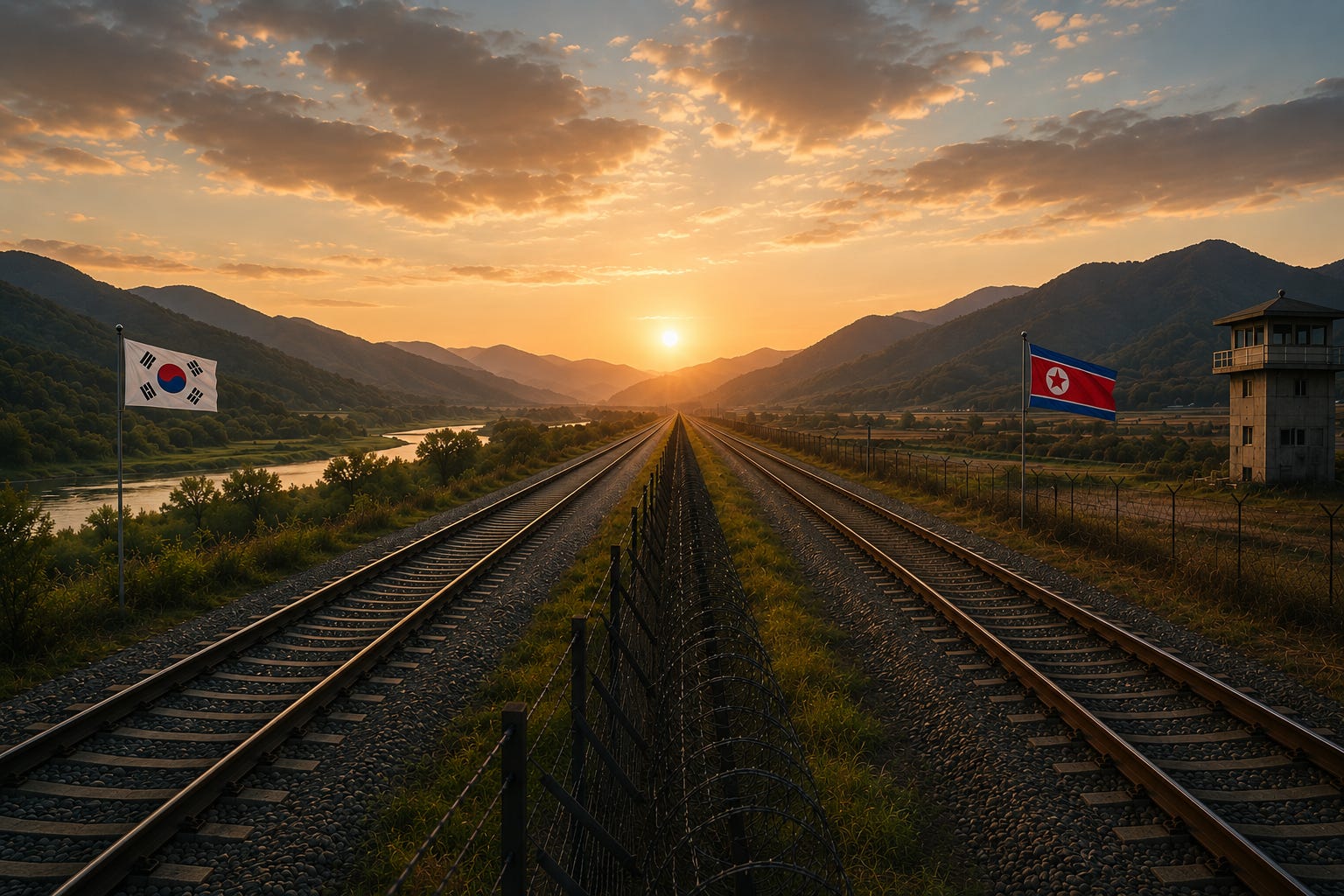
When South Korea’s Ministry of Unification released its 2026 White Paper in May, the shift in tone was stark. References to “peace” and “peaceful coexistence” surged to 196 from 29 in the previous edition; mentions of “dialogue” rose to 58 from 16. The document crystallized what President Lee Jae-myung has made the central organizing foreign policy approach of his administration: pragmatism over idealism.
The government’s revised policy toward North Korea rests on three guiding principles: respect for North Korea’s political system, rejection of unification by absorption, and the avoidance of hostile acts. The White Paper further identifies three main goals related to inter-Korean relations: institutionalizing inter-Korean peaceful coexistence, establishing a foundation for shared growth, and achieving a peninsula free of war and nuclear weapons.
From Unification to Coexistence
This recalibration reflects an honest reckoning with changed realities. Unification has long been enshrined in South Korea’s Constitution as a national goal, and Seoul has still not formally abandoned it. Yet the Lee administration’s embrace of pragmatism implicitly acknowledges what the polling data has been signaling for years. In 2025, a Korea Institute for National Unification survey found that just 49 percent of South Koreans said unification was necessary, the lowest level since polling began, with the decline observed across all generations.
The survey report described the shift as a “structural phase of change, moving beyond short-term fluctuations,” with 63.2 percent of respondents agreeing that unification is unnecessary as long as the two Koreas can peacefully coexist, marking the highest level of support for peaceful coexistence since that question was first introduced in 2016. South Korean society, in other words, has already moved toward coexistence. The Lee government’s policy reflects rather than leads this change.
Pyongyang’s position on the issue has also shifted, albeit more radically. In December 2023, Kim Jong Un formally abandoned unification as a national goal, instead describing the inter-Korean relationship as one between two hostile states. This marked a complete reversal of the DPRK’s long-standing policy of pursuing reunification with the South. To emphasize the long-term nature of the shift, the change in policy was reflected in the DPRK’s Constitution, with a revision earlier this year explicitly defining North Korea’s territory as bordering that of the “Republic of Korea” to the south for the first time. In other words, the DPRK both acknowledged its borders as limited to the northern half of the peninsula while de-facto recognizing the sovereignty of the ROK as a separate state.
Moreover, the removal of all unification-related language from the constitution and the absence of hostile characterizations of the South together suggest a deliberate move toward a legal framework premised on two-state coexistence. Whatever Pyongyang’s motivations, the constitutional revision serves to move the peninsula closer to the path of peaceful coexistence than ever before.
Challenges and Opportunities
The challenge, however, is that this apparent policy convergence from both sides of the 38th parallel on a two-state framework has not translated into a meaningful reduction of hostility or any resumption of dialogue. Inter-Korean relations remain frozen at their lowest point in decades.
The inter-Korean liaison office, demolished by Pyongyang in 2020, has not been restored. Military hotlines remain inactive. The 2018 Comprehensive Military Agreement (CMA), meant to prevent accidental military clashes, continues to be suspended. The vacuum created by the collapse of communication architecture is not merely inconvenient; it is dangerous. Without mechanisms for de-escalation or rapid clarification, even limited incidents carry real escalation risk. Especially in an environment of deep mutual mistrust, miscalculation may pose a greater threat than deliberate aggression.
Seoul’s leverage over Pyongyang has also eroded significantly in recent years. Russia and North Korea have agreed to long-term military cooperation, with Pyongyang having sent thousands of troops as well as missiles and munitions to support Russia’s war in Ukraine, receiving in return financial aid, military technology, food, and energy that help Pyongyang circumvent international sanctions. This collaboration has become an increasing security threat to Seoul, with the financial gains and Russian technological assistance having the potential to critically alter the inter-Korean military balance in the North’s favor. Given Pyongyang’s drastically emboldened position in 2026 compared to the summit era of 2018, there is little for Kim Jong Un to gain currently by engaging diplomatically with Seoul.
Notably, the collapse of bilateral trust under the previous administration compounded matters significantly. A special counsel investigation concluded that former ROK President Yoon Suk-yeol attempted to induce an attack from North Korea in order to justify his December 2024 emergency martial law declaration. The revelation that a sitting South Korean president likely sent drones into North Korean territory to engineer a pretext for domestic political purposes inflicted severe and lasting damage on whatever residual trust existed in Pyongyang. For Kim Jong Un, it confirmed the worst-case interpretation of Seoul’s intentions under conservative governments and further complicated the Lee administration’s efforts to reset the relationship from zero.
There are additional structural obstacles that Seoul’s peaceful coexistence framework does not fully resolve. The domestic consensus necessary for a durable coexistence policy does not yet exist. South Korea’s North Korea policy has historically been dismantled with each change of government, and Pyongyang has learned to discount Seoul’s commitments accordingly. The constitutional tension on the ROK side— Article 3 still defines ROK territory as encompassing the entire peninsula — also creates rhetorical vulnerabilities that opponents of the policy have not hesitated to exploit, as seen when the Unification Ministry was forced to defend its use of “two-state” language in the recent White Paper as not being unconstitutional.
And yet, for all these challenges, the case in favor of this policy path is stronger than the alternatives.
As North Korea continues to improve its conventional and nuclear military capabilities, the absence of dialogue does not preserve the status quo; it shifts the balance in Pyongyang’s favor. A policy that prioritizes communication restoration, military de-escalation, and incremental confidence-building over maximalist demands is more likely to be successful in building a foundation for stable, and eventually peaceful, coexistence between the two Koreas.
Despite headlines focusing mostly on North Korea’s aggressive rhetoric directed at Seoul, there are various cautious grounds for optimism.
The arrival in South Korea of a North Korean women’s football club last month— the first visit by North Korean athletes to the South in eight years— signals at least a residual willingness by Pyongyang to maintain some level of functional contact.
Moreover, on the diplomatic front, Trump has repeatedly signaled his desire to resume dialogue with Kim, reportedly telling South Korea’s prime minister in March 2026, “I maintain a good relationship with Kim Jong Un […] I am curious whether the chairman wants to engage in dialogue with the US or with me.”
For its part, Pyongyang has also signaled willingness to resume talks with Washington as long as the U.S. recognizes the DPRK as a nuclear state. While the latter remains the subject of much contention among the U.S. and its allies, Trump has previously referred to the DPRK as a “nuclear power” and the US 2026 National Security Strategy conspicuously omitted any reference to North Korean denuclearization as a goal.
With the U.S. currently bogged down in the Middle East and unable to end the conflict in Ukraine, Trump may be more willing to make certain concessions to land a diplomatic win with Kim Jong Un. Singapore’s foreign minster’s recent visits to both Pyongyang and Seoul further raises questions regarding the possibility of renewed diplomacy involving the DPRK, given Singapore’s critical role as a mediator and host between Trump and Kim in 2018.
The Path Forward
The Korean Peninsula’s path forward will not be linear, and the obstacles are structural, not merely situational. But the Lee government’s embrace of peaceful coexistence over the continued pursuit of reunification is the more viable strategic choice in the near term.
The most plausible path toward meaningful coexistence will require progress on several fronts.
Restoring inter-Korean communication lines is the most immediate priority, as the absence of basic channels for de-escalation remains the single greatest near-term risk. Alongside this, Seoul must work to build greater domestic and cross-party consensus around its North Korea policy, so that Pyongyang can reasonably expect continuity of engagement regardless of which government is in office.
Consistent, credible messaging toward the North, free from the volatility that has characterized past transitions, is essential to rebuilding even a minimal foundation of trust. Seoul should also continue to actively encourage renewed Pyongyang-Washington diplomacy, which remains the most viable lever for reducing military tensions and creating the conditions under which inter-Korean dialogue becomes possible.
Beyond the security track, identifying areas of genuine common interest, including climate resilience and cross-border environmental issues, may offer lower-stakes entry points for functional cooperation. And critically, Seoul must resist the temptation to respond in kind to North Korean military provocations, which have historically served to justify hardline positions on both sides and foreclose the very diplomatic space that coexistence requires.
While Seoul cannot compel Pyongyang to engage, it retains full agency over its own policy choices. In that regard, the pursuit of peaceful coexistence represents a meaningful step toward reducing tensions and laying the groundwork for restoring inter-Korean relations on a more durable and sustainable basis than any of the frameworks that preceded it.