


Xi Jinping arrived in Pyongyang today for a two-day summit with Kim Jong Un, marking the Chinese leader’s first overseas trip of 2026 and a choice that speaks volumes about the evolving balance of influence on the Korean Peninsula.
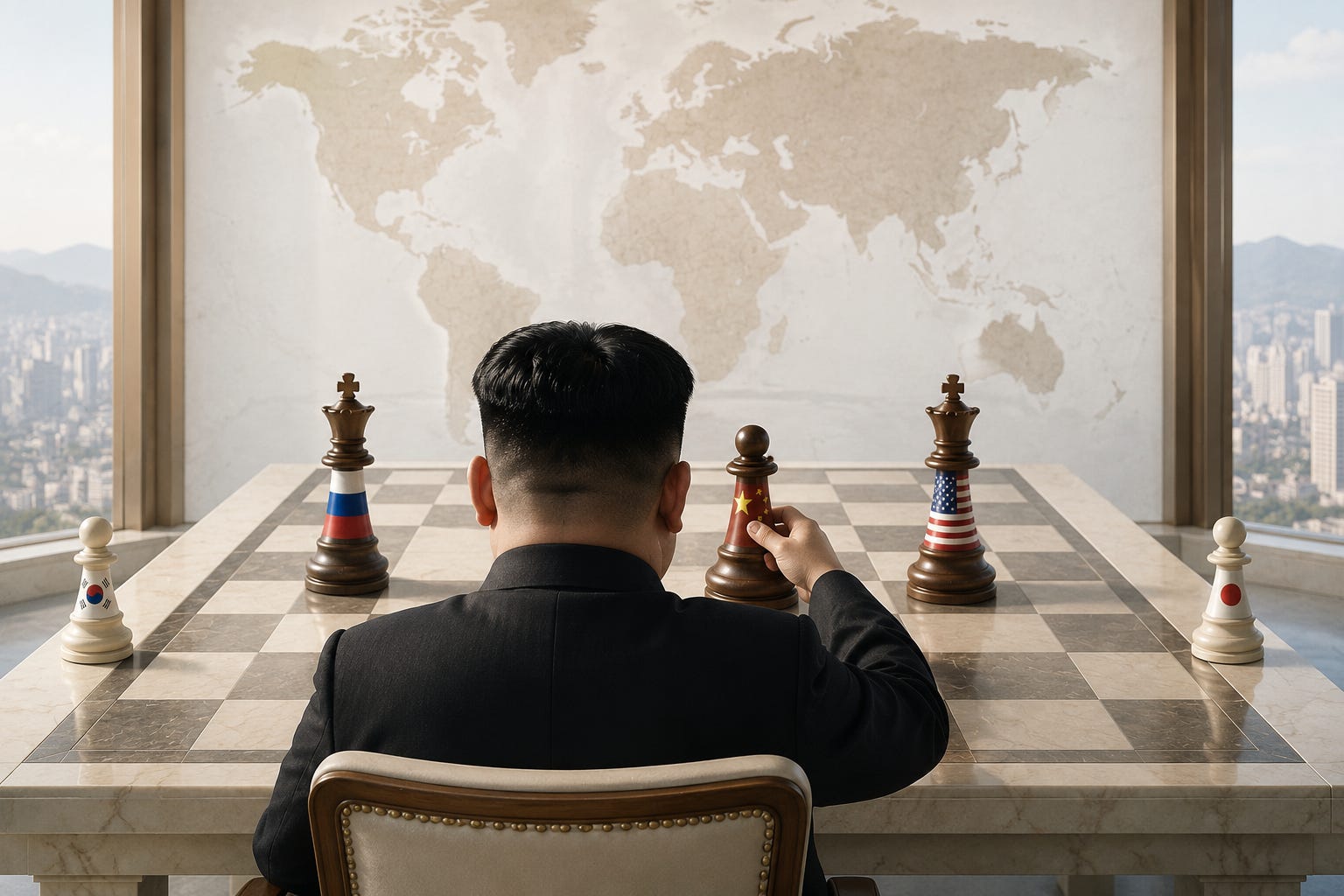
The significance of Xi’s visit is not merely that China and North Korea are drawing closer. It is that Kim Jong Un is becoming increasingly successful in replicating, and refining, a strategic environment his grandfather once exploited during the Cold War: one in which Pyongyang can extract maximum concessions from major powers while simultaneously minimizing dependence on any single patron.
With China seeking to reinforce its influence in Pyongyang, Russia in need of continued DPRK military support for its war in Ukraine, and the Trump administration quietly exploring pathways toward renewed engagement, North Korea has rarely enjoyed such simultaneous relevance to all three major powers.
An Old Playbook, Refined
North Korea’s capacity to extract leverage from great power competition is not new — it is a defining feature of Pyongyang’s strategic DNA. During the Cold War, Kim Il Sung repeatedly played Moscow and Beijing against one another, securing military aid, economic subsidies, and political backing from both while carefully avoiding subordination to either.
Following the Sino-Soviet split in the early 1960s, Pyongyang tilted opportunistically between the two powers, signing mutual defense treaties with both the USSR and China within five days of each other in 1961, leveraging their rivalry to extract favorable terms on various areas of interest.
This same logic is operating today. By deploying troops and munitions in support of Russia’s war in Ukraine, Pyongyang has simultaneously increased its strategic value to Moscow while raising the stakes for Beijing to reassert its relevance on the Korean Peninsula.
North Korea's deepening military cooperation with Russia has simultaneously sharpened Washington's urgency to find a diplomatic off-ramp before the DPRK's military capabilities advance further.
The result is a strategic environment in which the DPRK holds more leverage, more options, and more time on its side than at any point in decades.
Why Xi Is in Pyongyang
Placing Pyongyang at the top of Xi’s 2026 travel calendar is a signal of priority, not routine diplomacy. While a reciprocal visit by Xi to Pyongyang has been expected ever since Kim traveled to Beijing last September, Xi’s decision to make North Korea his first foreign trip of the year is a meaningful gesture, and Kim will likely have registered it as such.
Chinese motivations for the visit are various. This year marks the 65th anniversary of the Treaty of Friendship, Cooperation, and Mutual Assistance between China and North Korea, and the visit is, in part, meant to commemorate this event.
Beyond celebrating historic bilateral ties, however, there are several other strategic objectives at play concerning Xi’s trip.
First, Beijing is watching with unease as the Moscow-Pyongyang relationship deepens — not only through military cooperation, but across political, economic, and diplomatic channels as well.
In addition, Beijing has a fundamental interest in preserving stability on its northeastern frontier and preventing any development on the peninsula that could fracture regional security. Equally important is the long-term imperative of keeping North Korea within China's strategic orbit at a time when US-China competition is intensifying, a goal made more urgent by the prospect of a future Trump-Kim diplomatic opening that could sideline Beijing entirely.
Notably, Xi is arriving in Pyongyang having recently met both Putin and Trump— a positioning that allows him to present himself as a uniquely capable intermediary between Pyongyang and Washington. Having already hosted over 20 world leaders in China this year, Xi is cultivating the image of an indispensable global broker, one whose direct lines to a diverse cast of counterparts — including Kim — enhance China’s diplomatic relevance across multiple theaters.
Xi’s visit, then, is also a message to Washington: that any durable diplomatic architecture on the Korean Peninsula will have to run through China.
Kim’s Terms
North Korea, for its part, is making clear that any rapprochement will proceed on its own terms. Just one day before Xi’s visit was announced, Kim Jong Un made a visit to a new nuclear materials production facility. The message was unambiguous: Pyongyang’s nuclear status is not on the table, and China would do well to align itself with Russia in treating the DPRK, at least in practice, as a nuclear power.
If there was any doubt on this position, Kim Yo Jong made the DPRK’s stance explicitly clear the day before Xi’s visit. In an article published on Sunday by the Rodong Sinmun, she accused the US of spreading “baseless disinformation” regarding a recent State Department statement that said Trump and Xi reaffirmed their shared goal of the denuclearization of North Korea during their summit last month. Pyongyang’s message to Xi is therefore crystal clear: don’t even bother bringing up denuclearization; the issue is a non-starter.
This kind of signaling reflects Kim’s broader posture in 2026, which is one of increased boldness rather than urgency. He has weathered one of the toughest international sanctions regimes in history, a global pandemic, years of near-total border closure, and a dramatic contraction of his diplomatic partners. While North Korea continues to face serious economic constraints, its diplomatic leverage and strategic relevance have increased markedly.
Kim has shown no inclination to rush toward a deal with Trump. On the contrary, it is Washington that appears more eager for a diplomatic breakthrough, particularly given the administration’s failure to end the Ukraine war on its promised timeline and its entanglement in a new war in the Middle East. Russia, for its part, still needs North Korea for cheap arms and sustained military support. At the same time, China is going out of its way to prioritize reinforcing ties with the DPRK.
In other words, no side is in a position to dictate terms to Pyongyang.
What Comes Next
The visit is unlikely to produce any immediate diplomatic breakthrough. No single country — not China, not Russia — possesses sufficient leverage to compel Kim Jong Un to alter his strategic course.
What Xi can realistically offer is an expansion of bilateral economic exchanges, particularly valuable in an era of increasingly eroded sanctions enforcement, as well as a potential channel for indirect communication between Pyongyang and Washington. Whether Xi is carrying a message from Trump — perhaps exchanged during their recent summit — remains one of the most intriguing questions surrounding the visit.
For Moscow, there is little reason for alarm. Russia’s relationship with North Korea has grown sufficiently deep that it no longer depends on any single visit or symbolic gesture to sustain itself. High-level exchanges continue, the military relationship remains active, and Kim has little incentive to distance himself from Putin while the Ukraine war continues.
For Seoul, the implications are more complicated. The Lee Jae-myung administration has made peaceful coexistence with North Korea a central objective of its foreign policy. Yet growing competition among China, Russia, and the United States for influence in Pyongyang is likely to reduce Kim’s incentive to engage South Korea. If North Korea can secure economic benefits, diplomatic prestige, and strategic relevance through its relationships with major powers, the value of inter-Korean engagement inevitably declines.
Tokyo faces a similar challenge, as a more confident and better-connected North Korea has fewer reasons to make concessions on longstanding bilateral disputes.
At its core, Kim’s strategy toward the major powers is guided by a simple principle: extract maximum concessions while preserving as much strategic autonomy as possible.
For now, Kim’s main goal appears centered around achieving the gradual normalization of the DPRK’s nuclear status in practice. Russia has already moved in this direction. Should China follow suit, the United States would find itself increasingly pushed in the same direction regardless of its continued desire to denuclearize North Korea.
How Xi positions China on the nuclear issue will reverberate well beyond this visit— shaping Trump's calculus, narrowing or expanding Kim's room to maneuver, and moving the world either closer to or further from a new status quo Pyongyang has spent years quietly engineering.
North Korea doesn't pick sides, it picks leverage
An important feature of Pyongyang’s strategy is not only great-power balancing, but the exploitation of asymmetric urgency.
Russia needs military support now. China wants to preserve influence and prevent strategic drift. Washington wants to contain further nuclear and regional escalation. North Korea, by contrast, can afford to wait while its nuclear status becomes progressively normalised in practice.
This gives Pyongyang leverage, but not unlimited strategic independence. Its autonomy remains conditional on continued competition among the major powers. If their interests converge, or if Moscow’s wartime dependence declines, the space Kim currently exploits could narrow quickly.
The deeper success of the strategy is therefore not simply extracting concessions. It is keeping the surrounding powers divided enough that none can convert dependence into control.