


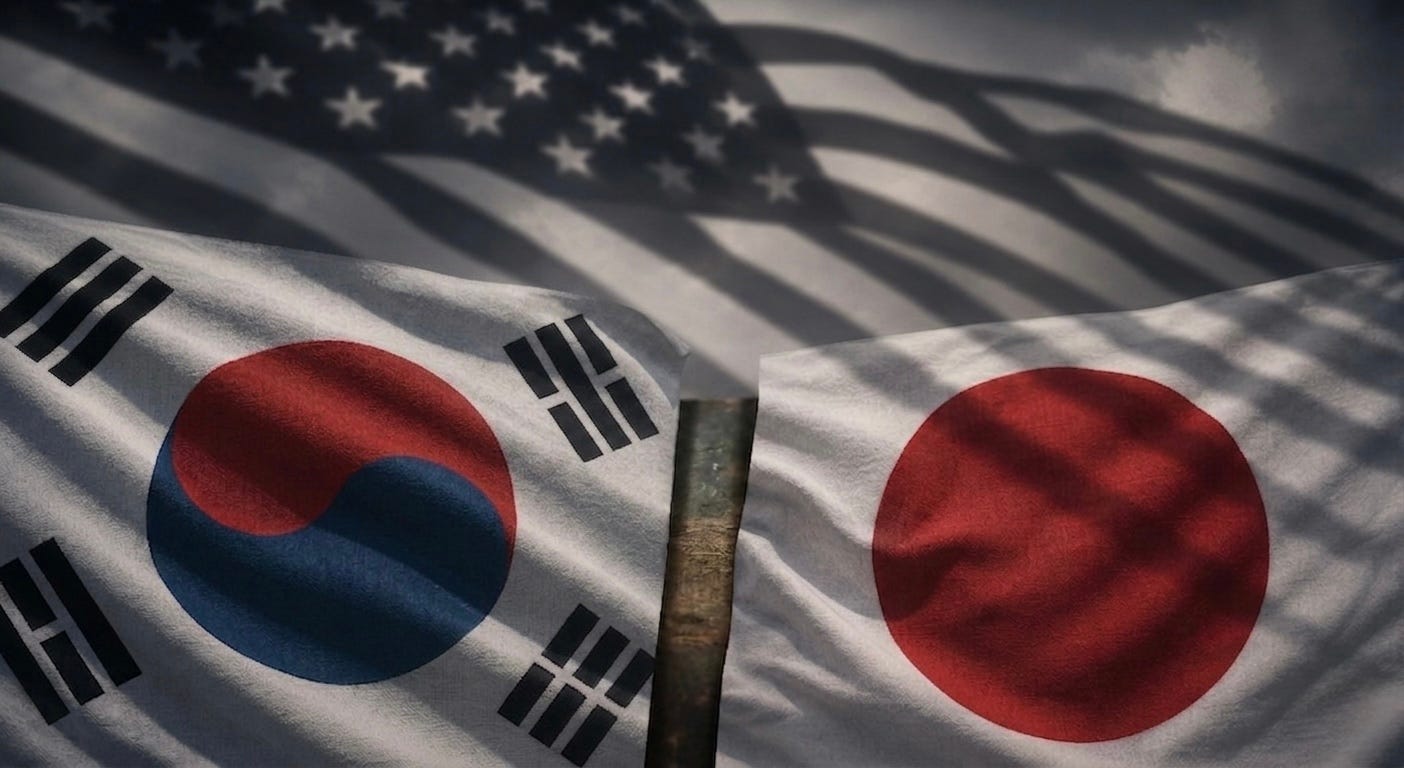
Concerns over the reliability of U.S. security guarantees, a more assertive China, and the persistent threat posed by North Korea are collectively pushing Seoul and Tokyo toward deeper bilateral coordination. While neither country is seeking to fully decouple from Washington, both are attempting to reduce their strategic exposure to fluctuations in U.S. policy.
Recent developments have sharpened those concerns considerably. Washington’s military redeployments away from the region to support operations in the Middle East have raised questions in both capitals about the future disposition of U.S. forces in Asia, while ongoing pressure from the Trump administration for allies to assume greater responsibility for their own defense has reinforced anxieties about alliance reliability.
At the same time, Beijing has sought to expand its regional diplomatic leverage through recent high-profile summits with both Donald Trump and Vladimir Putin. In particular, Trump’s more conciliatory rhetoric toward China during his recent meeting with Xi Jinping has sent mixed signals to Tokyo at a time when Japan-China relations have significantly deteriorated under Takaichi. Last week, China’s Foreign Ministry spokesperson reconfirmed Beijing’s ongoing ire toward Tokyo, stating that “Japan’s ‘country for peace’ mask is coming off and it is slipping towards neo-militarism.”
Taken together, these overlapping developments have noticeably accelerated cooperation between South Korea and Japan. This momentum is being driven less by any substantive resolution of historical grievances than by a converging assessment in both capitals that the regional security environment is growing more volatile, less predictable, and increasingly requires tighter coordination between the two U.S. allies.
A series of recent leader-level meetings reflects this broader reframing of bilateral ties. Whereas Seoul–Tokyo relations over much of the past decade were prone to sharp downturns whenever historical disputes resurfaced, the current phase is increasingly anchored in shared strategic calculations rather than efforts at reconciliation. That shift may make cooperation more durable in the short term, but it also risks hardening the relationship into something more explicitly transactional and security-centric—an arrangement that could prove structurally limited if the underlying historical and political frictions remain unresolved.
A Pragmatic Approach
The foundations of the current rapprochement were laid under former ROK President Yoon Suk-yeol, whose administration prioritized repairing ties with Japan and significantly expanded trilateral cooperation among Seoul, Tokyo, and Washington.
When progressive President Lee Jae-myung took office in 2025, some observers anticipated a partial reversal. Instead, Lee has largely maintained the strategic direction established under his predecessor, albeit with different political framing.
Rather than emphasizing values-based alignment or explicitly foregrounding trilateralism, Lee has approached engagement with Tokyo through the language of pragmatism and national interest, reflecting an understanding that the structural pressures driving closer ties with Japan have not disappeared with a change in administration.
That balancing act remains politically delicate. Historical grievances tied to Japan’s colonial rule of Korea continue to carry substantial domestic resonance in South Korea, particularly among progressive constituencies traditionally skeptical of security cooperation with Tokyo. Lee has therefore attempted to separate historical disputes from contemporary strategic coordination without appearing dismissive of unresolved issues. At a press conference marking his first 100 days in office, he summarized the approach succinctly: “We shouldn’t neglect history, but there are areas where we can cooperate.”
Various factors are pushing the two neighbors toward greater cooperation. Japan-China relations have deteriorated sharply under Takaichi, particularly due to Tokyo’s increasingly vocal support for Taiwan and Japan’s accelerating defense buildup. Beijing has accused Japan of abandoning its postwar pacifist identity and moving toward “neo-militarism,” language directed at pressuring Tokyo while also serving as a signal to Seoul about possible negative implications of deeper alignment with Japan.
While Seoul is unlikely to openly align itself with Japan in the latter’s ongoing dispute with Beijing, greater cooperation with Tokyo still come with risks.
Seoul’s significant economic exposure to China means it won’t want to risk another THAAD-like retaliation by openly supporting a more militarized Japan. Moreover, the ROK’s continued preference for strategic ambiguity on Taiwan-related contingencies also imposes clear limits on policy convergence between Seoul and Tokyo.
Nevertheless, shared concerns about U.S. alliance uncertainty and North Korea’s expanding military capabilities have proven sufficient to sustain bilateral momentum despite those differences, at least for now.
Diplomatic symbolism has reinforced this direction. Lee selected Japan for his first official bilateral meeting abroad after taking office, an unusual choice for any South Korean president. Similarly, Lee’s recent January summit with Prime Minister Sanae Takaichi projected an image of pragmatic neighborliness rather than ideological alignment. Takaichi’s subsequent visit to Lee’s hometown of Andong earlier this month carried similar symbolic weight, with the two leaders agreeing to expand cooperation in various areas.
Expanding Cooperation
The momentum in bilateral ties is increasingly visible in concrete policy coordination. At the Lee-Takaichi summit in Andong earlier this month, both governments agreed to strengthen coordination on securing crude oil and liquefied natural gas supplies amid ongoing instability surrounding the Strait of Hormuz, a critical chokepoint for both economies. The agreement reflected a growing recognition in Seoul and Tokyo that economic security can no longer be separated from broader geopolitical risk.
The energy dimension builds on earlier institutional groundwork. A March memorandum of understanding between Japan’s JERA and the Korea Gas Corporation established mechanisms for LNG supply coordination and potential cargo swaps during emergencies. In parallel, Seoul is expected to enhance energy cooperation with Tokyo under Japan’s POWERR Asia initiative — a regional energy security effort aimed largely at aiding neighbors in strengthening their energy resilience.
Economic security cooperation is also deepening. At the Andong summit, both sides announced plans to further expand the bilateral Supply Chain Partnership Arrangement signed earlier this year. The ROK and Japan remain highly dependent on external supply chains vulnerable to geopolitical disruption, particularly in the event of intensified U.S.-China competition or regional conflict.
In the security domain, Japan and South Korea recently convened their bilateral Security Dialogue at the vice-ministerial level for the first time, upgrading the mechanism from the previous director-general level. The institutional elevation is significant because it signals a shift from ad hoc coordination toward more routinized strategic consultation. The two governments also agreed to deepen trilateral communication with the United States and establish regular vice-ministerial “two-plus-two” consultations involving defense and foreign affairs officials.
Taken together, these developments point toward a gradual institutionalization of cooperation that would have been politically difficult only a few years ago. The pace of change has been notable enough that former U.S. Ambassador to South Korea Mark Lippert recently observed that “there has rarely been a time when Korea-Japan relations were as good as they are now.”
The Limits of Alignment
Yet despite the current momentum, the rapprochement still faces important structural constraints that will shape how far the relationship can ultimately evolve.
Historical disputes remain unresolved and politically combustible. Forced labor issues, wartime memory, and territorial disputes continue to shape public perceptions in both countries, particularly in South Korea. For instance, President Lee in February rejected a U.S. proposal to stage a trilateral aerial exercise with Japan as the date for the suggested drills aligned closely with Japan’s “Takeshima Day”, an annual celebration of its territorial claim to the Dokdo islets which the ROK considers part of its sovereign territory.
The current thaw therefore rests heavily on political management by leaders in Seoul and Tokyo rather than on any genuine resolution of underlying grievances. A future political crisis or domestic backlash could still destabilize the relationship relatively quickly.
Differences over North Korea policy also impose limits on deeper strategic alignment. Japan has traditionally favored a harder-line approach centered on deterrence, sanctions, and denuclearization pressure, whereas the Lee administration has signaled greater interest in diplomatic engagement with Pyongyang.
That divergence was visible during the Andong summit itself: While the Japanese readout of the meeting explicitly mentioned the “denuclearization of North Korea,” Lee instead called for “peaceful coexistence” on the Korean Peninsula.
Such differences do not preclude cooperation, but they do complicate deeper coordination on contingency planning involving North Korea. Seoul and Tokyo continue to prioritize somewhat different end states and risk calculations regarding the peninsula, particularly when it comes to balancing deterrence with diplomatic flexibility.
Japan’s military normalization trajectory presents an additional long-term challenge. Under Takaichi, Tokyo has accelerated defense spending and expanded debate around counterstrike capabilities and constitutional reinterpretation. While some in Seoul may quietly support a more capable Japanese security role in balancing regional threats, public sensitivities remain acute. Beijing is also likely to intensify efforts to frame closer ROK-Japan security cooperation as evidence of emerging bloc politics aimed at containing China.
This places Seoul in a difficult strategic position. South Korea’s security architecture still depends fundamentally on the United States, while its economic relationship with China constrains its freedom of maneuver. Closer ties with Japan could strengthen deterrence and economic resilience, but they also risk generating political and economic costs if Beijing comes to perceive the relationship as evolving into a more formal anti-China alignment.
Nevertheless, the broader logic driving cooperation is unlikely to disappear. Even if U.S. commitments ultimately remain robust, the perception of uncertainty itself is already reshaping regional strategic behavior. Both Seoul and Tokyo increasingly appear to be planning for a future in which American support may become less automatic, less predictable, or more conditional than in previous decades.
That does not mean the U.S. alliance system in Northeast Asia is collapsing. Rather, it suggests that America’s allies are adapting to a more fluid strategic environment by building denser regional partnerships of their own. For South Korea and Japan, that adaptation is no longer simply about improving bilateral relations for their own sake; it is increasingly becoming part of a broader effort to hedge against strategic volatility in an increasingly unstable regional and global order.
The near-term trajectory therefore points toward continued institutionalization of bilateral and trilateral frameworks, deeper economic security coordination, and sustained high-level engagement.
The more consequential test, however, will come if those frameworks are forced to respond to a real regional contingency— whether on the Korean Peninsula, in the Taiwan Strait, or through a broader crisis involving U.S.-China competition. Only then will it become clear whether the current rapprochement represents a temporary alignment of convenience or the emergence of a more durable strategic partnership.