


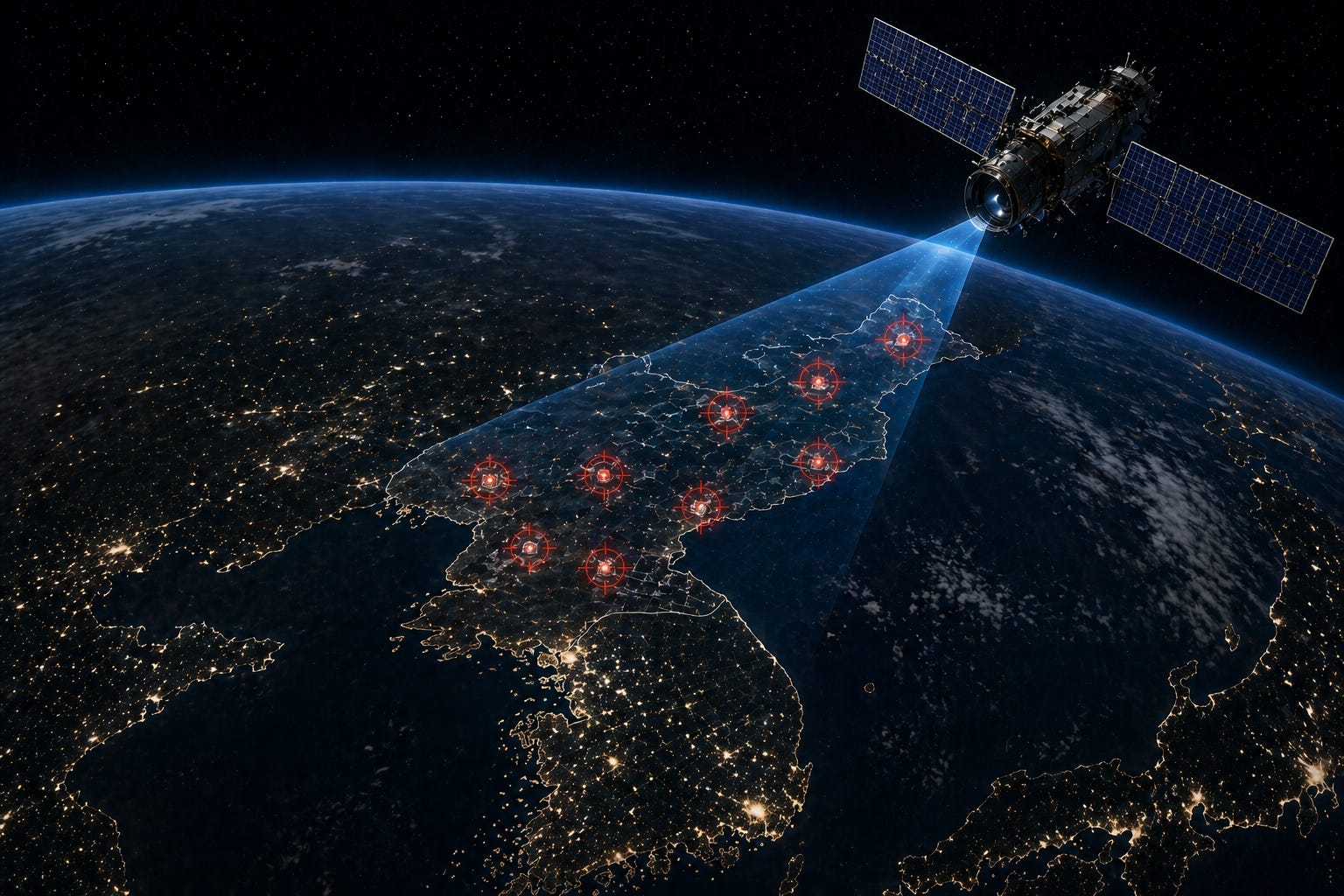
Reports alleging a partial halt in US intelligence sharing with South Korea represent the latest test of an alliance already navigating significant strain. According to multiple South Korean media sources, the United States suspended the sharing of satellite imagery related to North Korean nuclear facilities after Unification Minister Chung Dong-young publicly identified Kusong in North Korea’s North Pyongan Province as a uranium enrichment site—a location not previously acknowledged publicly by either government. Although Minister Chung indicated the information was derived from open-source materials, US officials reportedly treated the disclosure as a breach involving classified intelligence.
South Korean Defense Minister Ahn Gyu-back and other officials have sought to downplay the implications of Chung’s remarks, and South Korean military officials confirmed that intelligence sharing surrounding recent North Korean missile launches was unaffected, suggesting any restriction may be limited to the nuclear domain.
Although any restriction in intelligence sharing on Washington’s part remains unconfirmed at the official level, the ongoing incident is still analytically significant and worth examining more closely. Whether or not the suspension occurred precisely as reported, it surfaces a structural question that has grown more pressing as the alliance adapts to new strategic realities: under what conditions is Washington prepared to limit intelligence sharing with Seoul?
That question matters independently of this specific episode, particularly given South Korea’s sustained push to develop independent surveillance capabilities and the broader recalibration underway within the US-ROK alliance. In addition to highlighting ongoing vulnerabilities regarding Seoul’s intelligence collection capabilities, the episode also serves to accelerate the political justification for greater ROK defense autonomy investments that were already well underway on military and strategic grounds.
Closing the Gap
South Korea has long relied on US intelligence, surveillance, and reconnaissance (ISR) capabilities, particularly satellite-based systems, but has taken deliberate steps over the past decade to reduce that dependence. The clearest expression of this effort is the 425 Project, a long-term defense initiative completed in November 2025 with the launch of its fifth and final reconnaissance satellite.
The constellation integrates one electro-optical and infrared (EO/IR) satellite with four synthetic aperture (SAR) radar satellites, providing around-the-clock monitoring regardless of weather or lighting conditions. Designed to support the Kill Chain preemptive strike system, the network is intended to provide real-time tracking of North Korean nuclear and missile activities. With all five satellites approaching full operational capability, the project will meaningfully improve South Korea’s capacity to monitor the North.
Existing ROK defense planning envisions expanding this architecture further, with approximately 60 additional small and microsatellites targeted for deployment by 2030, aimed at increasing revisit rates and reducing surveillance gaps.
Limitations
Despite these advances, the 425 constellation carries important operational constraints. The system’s integrated two-hour revisit cycle represents a meaningful improvement over previous capabilities. However, the two-hour window reflects the constellation’s combined performance across all five assets. For any individual satellite, revisit intervals are longer: SAR satellite coverage allows approximately four to six observations per day over the peninsula, implying gaps of several hours between passes for any individual asset.
The operational implications are significant. North Korea is assessed to be capable of preparing a missile launch within 30 to 40 minutes. A two-hour integrated cycle paired with significantly longer intervals for individual satellites creates periods of limited visibility that mobile platforms such as transporter-erector-launchers can exploit. In other words, persistent, multi-target surveillance across all high-priority sites simultaneously remains beyond current capacity. The 60-satellite expansion plan is specifically designed to close this gap by driving revisit times below 30 minutes, but that capability is years away.
Moreover, military officials have highlighted concerns over delays in real-time intelligence sharing with the United States, noting that during the satellite deployment phase, certain U.S. intelligence inputs were either delayed or restricted. This raises questions about the effectiveness of the Kill Chain, which depends on rapid detection, identification, and strike decisions within a compressed timeframe.
Compounding Challenges Facing the Alliance
Reduced intelligence sharing by the US in specific domains could carry tangible operational consequences for South Korea. For one, restricted access to high-sensitivity intelligence on nuclear facilities or weapons development could slow early warning timelines and complicate crisis decision-making. But the implications extend beyond operational utility. Intelligence exchange is a core mechanism for building trust, aligning threat perceptions, and enabling coordinated planning. Disruptions in this domain, even partial or temporary, carry broader consequences for alliance cohesion.
In particular, the more consequential risk lies in contingency scenarios. Washington has demonstrated a willingness to limit or withhold intelligence from allies when operational security concerns arise. In high-stakes situations, intelligence-sharing decisions could become more restrictive, not less.
For example, in the event of the US considering covert or preemptive options against North Korean nuclear infrastructure, Seoul could find itself with significantly less visibility into US decision-making than it expects. Reports of alleged contingency planning during the Trump administration in 2019, particularly a purported covert Navy Seal special operation, suggest this is not a hypothetical concern. In such scenarios, intelligence asymmetries within the alliance would widen precisely when they matter most.
Beyond Seoul, Tokyo is also taking active steps to enhance its intelligence capabilities. On April 23, Japan’s lower house passed legislation to establish a National Intelligence Council chaired by the prime minister, consolidating intelligence functions currently dispersed across various bodies. The move is being described by some analysts as “the most significant reform of the country’s intelligence architecture in the postwar era.”
As each ally enhances their autonomous intelligence structures, sustaining effective trilateral coordination will require consistent efforts at intelligence sharing to ensure that Washington, Seoul, and Tokyo are not only well-prepared to defend their own nations in a crisis scenario, but also positioned to act collectively in the interest of broader regional security.
Implications for Seoul’s Strategic Posture
The current episode should be understood less as an isolated disruption than as a politically clarifying moment within a longer strategic trend.
South Korea’s drive toward greater defense autonomy predates this incident and is grounded in military requirements that exist independently of any single intelligence-sharing dispute. Most concretely, the conditions for wartime operational control (OPCON) transfer— currently targeted to take place within President Lee Jae-myung’s term— require South Korea to demonstrate credible capabilities across a defined set of domains.
ISR could be one of the most demanding of these thresholds. Meeting the needed operational capabilities to allow for OPCON transfer requires the significant strengthening of Seoul’s intelligence capabilities, likely encompassing the ability to conduct independent surveillance and reconnaissance at a level sufficient to lead combined operations. The 425 Project and the planned small-satellite expansion are in direct service of meeting those requirements.
The ongoing challenge for Seoul will lie in pursuing greater autonomy while preserving the functional benefits and necessity of alliance integration. These objectives are not incompatible, but their alignment requires careful management.
American ISR capabilities will remain unmatched in the near term, and continued access to those capabilities will be essential for deterrence and crisis management. The short-term goal is not replacement but resilience: building the capacity to absorb disruptions without operational paralysis, while maintaining the alliance cooperation that remains central to peninsular security.