


Download the PDF version of the report below:
In Brief
The strategic environment surrounding the Korean Peninsula has changed significantly since the collapse of US-DPRK diplomacy in Hanoi in 2019, challenging many of the assumptions that have underpinned policy toward North Korea for decades.
This paper examines five areas where emerging status quos appear to be taking shape: the gradual movement toward de facto acceptance of North Korea’s nuclear status, the declining effectiveness of sanctions, the evolution of inter-Korean relations toward long-term coexistence, the pursuit of greater strategic autonomy by US allies, and the increasing internationalization of the DPRK issue.
While these shifts vary in their likely durability, together they point to a broader transformation of the peninsula’s strategic environment. An expert survey of sixteen specialists identified the decline in sanctions effectiveness as the most durable emerging status quo, while de facto nuclear acceptance and the internationalization of the DPRK issue were viewed as more contingent on future geopolitical developments.
These developments have expanded North Korea’s strategic room for maneuver by weakening international pressure, reducing its isolation, and increasing its relevance within wider geopolitical competition.
For the United States, South Korea, Japan, and other stakeholders, the principal implication is not that longstanding objectives should necessarily be abandoned, but that the assumptions and policy instruments developed under earlier strategic conditions may require reassessment. As the strategic environment continues to evolve, policies that fail to adapt risk becoming progressively less effective in managing the DPRK challenge and preserving stability on the Korean Peninsula and beyond.
I. Introduction
The Korean Peninsula of 2026 is markedly different from the one that existed when US-DPRK diplomacy reached record highs in 2018-19. During the intervening years, the strategic environment surrounding the peninsula has undergone significant change, driven by an increasingly emboldened DPRK, declining consensus among major powers on North Korea policy, intensifying US-China rivalry, weakened ROK leverage over the DPRK, a near-total breakdown in inter-Korean relations, and the growing interconnectedness of regional and global security challenges.
Together, these developments are making it increasingly difficult to rely on many of the assumptions that have underpinned international policy toward North Korea since the end of the Cold War.
To explore this further, this research paper analyzes five areas where a new status quo may be taking shape: the gradual movement toward de facto or passive acceptance of North Korea’s nuclear status; the declining effectiveness of sanctions as a tool of coercion; the transformation of inter-Korean relations from a reunification framework toward one of long-term coexistence between two separate states; the pursuit of greater strategic autonomy by US allies; and the increasing internationalization of the North Korean threat.
Much of the debate surrounding the Korean Peninsula focuses on individual developments, from North Korea’s nuclear program and sanctions to alliance politics and inter-Korean relations. Less attention has been paid to whether these developments, taken together, signal a broader transformation of the peninsula’s strategic environment. This paper argues that they do.
For the purposes of this paper, an emerging status quo refers to a pattern of change that, while not yet fully consolidated, is increasingly shaping policy toward the DPRK, perceptions of the security environment on the Korean Peninsula, the strategic calculations of regional actors, and the range of diplomatic, military, and economic tools available to them.
Although these developments remain contested and may evolve in different ways, they are already influencing the conditions under which decisions on deterrence, diplomacy, sanctions, alliance management, and inter-Korean relations are made.
Understanding these shifts matters because policies developed for an earlier strategic environment may become progressively less effective as the assumptions on which they were based erode. Identifying these emerging status quos can therefore help policymakers distinguish between temporary developments and more durable shifts, enabling them to adapt strategies for managing the DPRK challenge and preserving stability on the Korean Peninsula and in the wider region.
II. Changes Shaping the Korean Peninsula’s Strategic Landscape
1. The Nuclear Recognition Issue
The most recent consequential shift concerning the Korean Peninsula relates to how great powers perceive North Korea’s nuclear weapons program. While denuclearization remains the official policy of the United States and its allies, its achievement grows increasingly elusive. Major powers seem to increasingly be moving toward tacit or reluctant acceptance of the DPRK’s nuclear status, and Kim Jong Un has consistently refused to entertain even the possibility of giving up his arsenal — together eroding what had, until recently, been a near-universal strategic goal.
As Pyongyang deepened its military support for Moscow in recent years, the latter has progressively shifted its position toward de facto acceptance of the DPRK as a nuclear state. Back in September 2024, Russian Foreign Minister Sergei Lavrov made his country’s position on the issue clear, stating that the denuclearization of North Korea was “a closed issue,” explaining that “the very term of ‘denuclearization’ as applied to North Korea has lost all meaning.” Earlier this year, Lavrov reiterated this position, dismissing US calls for denuclearization as irrelevant.
While nowhere near as openly supportive as Russia, China has become noticeably less vocal in pressing Pyongyang on denuclearization. Although Beijing continues to support the denuclearization of the Korean Peninsula (at least in principle, repeatedly reaffirming the “consistency” of its Korean Peninsula policy), the practical salience of denuclearization in Chinese policy appears to be declining.
This was evident during Xi Jinping’s recent summit with Donald Trump, where both sides reportedly reaffirmed their shared support for denuclearization according to the U.S. readout, but the issue was omitted from China’s own account of the meeting. Similarly, during Xi’s June 2026 summit with Kim Jong Un in Pyongyang, denuclearization was notably absent from public discussions despite extensive talks on bilateral cooperation.
While these developments do not constitute Chinese acceptance of North Korea’s nuclear status, they suggest that Beijing increasingly views the issue as subordinate to broader priorities such as regional stability, strategic competition with the United States, and maintaining influence over Pyongyang. This represents a major win for North Korea, as it demonstrates Beijing’s unwillingness to make the bilateral relationship contingent on nuclear progress.
In short, China’s position increasingly seems to be more aligned with reluctant acceptance or, at the very least, passive acknowledgement of the DPRK’s nuclear status.
Beyond the (in)action of major powers on the nuclear issue, Pyongyang has taken its own deliberate steps to entrench its nuclear status. In 2022, a new law was passed to enshrine the country’s nuclear status as legally permanent and explicitly irreversible, removing even the notional possibility of nuclear negotiations as a feature of state policy. Since Trump’s return to office in early 2025, Kim has set US recognition of North Korea as a nuclear state as the precondition for any resumption of dialogue — a position from which he has not moved despite multiple expressions of interest in engagement from Washington.
With both Moscow and Beijing in his corner, Kim Jong Un has little incentive to engage in any talks that place denuclearization on the table. Whether this posture ultimately pays off — for instance, by nudging Washington toward quietly following Beijing’s lead — remains to be seen. Trump will be reluctant to be seen as making major concessions, and abandoning denuclearization, or even signaling de facto acceptance of the DPRK as a nuclear state, would represent the single greatest concession the United States could extend to the Kim regime.
2. The Unraveling of the Sanctions Regime
For much of the past two decades, sanctions have been the international community’s primary instrument for pressuring North Korea to curb its nuclear and missile programs. While sanctions continue to impose significant costs on the DPRK economy and restrict its access to international markets, their effectiveness as a tool for constraining Pyongyang’s strategic capabilities has declined substantially in recent years.
In particular, the effectiveness of sanctions has always depended not only on the restrictions contained in UN Security Council resolutions, but also on sustained cooperation among major powers to monitor, enforce, and expand those measures when necessary.
That foundation has eroded considerably. In 2022, Russia and China vetoed a proposed UN sanctions package targeting North Korea, marking the first time both countries had blocked new sanctions measures against Pyongyang. The more consequential development came in March 2024, when Russia vetoed the renewal of the UN Panel of Experts, the body responsible for investigating sanctions violations and monitoring implementation. Although the sanctions regime formally remains in place, the removal of its principal monitoring mechanism significantly weakened the international community’s ability to identify, document, and respond to violations.
The Multilateral Sanctions Monitoring Team (MSMT), established by the United States and ten partner countries later that year, was intended to partially fill this gap. However, unlike the UN mechanism it replaced, the MSMT lacks universal legitimacy and operates without the participation or support of either Russia or China. Its ability to generate political pressure is therefore considerably more limited.
At the same time, North Korea’s expanding strategic partnership with Russia since 2022 has further undermined sanctions effectiveness. Military cooperation between the two countries has reportedly generated billions of dollars in revenue for Pyongyang while providing access to sensitive military technologies and political cover that sanctions were specifically designed to deny. Far from constraining North Korea’s military development, the current environment has coincided with continued advances across its nuclear forces, missile capabilities, and conventional military modernization.
While sanctions continue to severely restrict North Korea’s legal economic activity, they have failed in their primary objective: halting the growth of its nuclear and missile programs. Despite remaining one of the most heavily sanctioned states in the world, Pyongyang has continued to expand its arsenal, improve its delivery capabilities, deepen military cooperation with major powers, and strengthen its conventional forces. Moreover, according to the ROK central bank, the North Korean economy grew nearly 4% in 2024 — its fastest pace in eight years — driven in part by deepening ties with Moscow.
In short, the sanctions architecture remains formally in place, but its ability to alter North Korea’s strategic trajectory has been substantially weakened.
3. From Unification to Coexistence?
Few developments since 2019 have altered the Korean Peninsula’s political landscape more fundamentally than the transformation of inter-Korean relations. For decades, despite profound disagreements regarding how reunification should occur, both Koreas formally maintained it as their ultimate national objective. In 2026, however, that shared premise no longer exists.
The most consequential shift came in December 2023, when Kim Jong Un formally abandoned reunification as a state objective and redefined relations with South Korea as those between two separate and hostile states. This represented more than a rhetorical adjustment. It marked a fundamental departure from the framework that had underpinned inter-Korean relations since division, replacing the concept of eventual national reunification with one of permanent separation.
Since then, Pyongyang has systematically reinforced this position. Inter-Korean communication channels remain largely dormant and North Korea has shown no interest in re-engaging with Seoul despite repeated outreach efforts by the South Korean government. As of 2026, inter-Korean relations remain effectively frozen.
North Korea’s unwillingness to engage reflects both strategic and structural considerations. Since the collapse of the Hanoi summit, Pyongyang appears to have concluded that meaningful progress on issues it considers most important — particularly sanctions relief, security guarantees, and recognition of its nuclear status — can only be achieved through direct engagement with Washington rather than through Seoul acting as an intermediary.
At the same time, North Korea’s deepening ties with Russia and China have reduced its dependence on South Korea as a source of economic or diplomatic leverage. In practical terms, there is relatively little that Seoul can currently offer that Pyongyang cannot obtain elsewhere.
These developments have also affected policymaking in the South. While reunification remains enshrined in the South Korean constitution and continues to serve as the formal long-term objective of state policy, the Lee Jae-myung administration has increasingly framed its near-term approach around the concept of peaceful coexistence. This shift does not constitute an abandonment of reunification. Rather, it reflects an acknowledgement that the political conditions necessary for meaningful progress toward that goal are currently absent and that policy must adapt to the realities of a prolonged period of separation.
In addition to the coexistence framework for inter-Korean relations, the Ministry of Unification also raised the possibility of more consistently referring to North Korea by its official designation— the DPRK. Critics argue that such moves risk legitimizing Pyongyang’s two-state framework, with some even calling it unconstitutional. Supporters, however, counter that using the North’s official designation would reflect the reality of contemporary inter-Korean relations and could serve as a first step toward realizing the goal of peaceful coexistence.
While the two Koreas have functioned as two separate states for decades, the current shift points to something more long term—namely, an emerging status quo grounded in concrete legal changes in Pyongyang and a fundamental reorientation of unification policy in Seoul. This shift is more likely to be entrenched in the North, however, given the high political costs involved with revising the ROK’s constitution in the near term.
4. Greater Pressure on U.S. Allies
Questions surrounding Washington’s commitment to the security of its allies in the region have become increasingly pronounced since Trump’s return to office in 2025.
Presidential attention to Northeast Asia has diminished relative to the Biden years, with Trump instead concentrating significant diplomatic and military bandwidth on the Middle East, closing business deals abroad, and reinforcing US influence in the Western Hemisphere— leaving much of alliance management in Northeast Asia lower on his list of priorities.
More recently, the redeployment of missile-defense assets from Northeast Asia to the Middle East raised further questions regarding how Washington would prioritize competing theater requirements during a major crisis. Repeated demands for greater burden-sharing have also reinforced the increasingly transactional character of Washington’s relationships with both Seoul and Tokyo.
The result of these concerns is a security environment in which confidence in formal alliance commitments increasingly coexists with active preparation for their potential limitations.
In response to these shifts, South Korea has committed to raising defense spending to 3.5 percent of GDP and pledged USD 25 billion in US weapons purchases — moves Washington has applauded. In addition, the Lee administration has made wartime operational control (OPCON) transfer a national priority, with President Lee explicitly linking the transition to “defense autonomy” and framing it as evidence of South Korea’s willingness to assume greater responsibility for peninsula security. The ROK’s defense budget for 2026 also allocates USD 44.8 billion under the banner of “self-reliant defense” — a 7.8 percent increase from the previous year. Beyond defense spending, Seoul’s pursuit of a nuclear-powered submarine, which Trump approved in late 2025, further strengthens the ROK’s trajectory toward greater defense autonomy.
Beyond rhetorical and economic pressure by Washington, these autonomy imperatives have been further sharpened by growing concerns over entrapment. As discussions surrounding the future role of US Forces Korea (USFK) have expanded beyond deterring North Korea, some ROK officials have pushed back against such interpretations, arguing that South Korean forces must remain focused on the North Korean threat. Concerns that a Taiwan contingency could lead to the redeployment of US assets from the peninsula, leave Seoul more exposed to North Korean coercion, or draw it into a conflict with China have also lent additional urgency to the case for strategic autonomy.
Japan’s trajectory, while constrained by constitutional and political considerations, reflects many of the same underlying concerns shared in Seoul. The Takaichi government brought defense spending to 2 percent of GDP in fiscal year 2025, two years ahead of schedule, and the fiscal year 2026 defense budget of approximately USD 58 billion keeps Japan on track to become the world’s third-largest defense spender. More than USD 6 billion within that budget is allocated to standoff missile capabilities, marking a significant departure from Japan’s traditional postwar defense posture.
The April 2026 revision of Japan’s arms export policy served to further reinforce this trajectory. The new framework permits the export of lethal defense systems to seventeen partner countries, representing a significant departure from longstanding restrictions on Japanese military exports. Takaichi’s government has also pledged to revise Japan’s National Security Strategy, National Defense Strategy, and Defense Buildup Program before the end of the year.
At the same time, constitutional revision has moved closer to the political mainstream. Public opinion has shifted increasingly in favor of revision under Takaichi, though the issue remains highly contested. Crucially, Takaichi’s February 2026 electoral victory has given the governing coalition sufficient parliamentary support to initiate a potential revision process.
The trend toward greater defense autonomy among US allies in the region does not equate with the collapse of these long-held “ironclad” alliances. The relationship with the United States remains the foundation of both countries’ security postures, and no amount of defense spending hikes is likely to replace the role played by Washington any time soon.
Still, faced with growing uncertainty regarding future US priorities, an increasingly complex regional security environment, and North Korea’s continuously advancing military capabilities, maintaining the same level of security dependence on the US as in the past seems increasingly risky.
5. The Internationalization of the North Korean Threat
For much of the post-Cold War period, the Korean Peninsula was treated as a largely self-contained security problem requiring dedicated policy tools and management mechanisms. Although developments involving North Korea carried broader regional implications, policy toward Pyongyang was generally approached through a relatively narrow framework centered on denuclearization, deterrence, sanctions, alliance management, and inter-Korean relations.
That framework is becoming increasingly difficult to sustain. Today, the North Korea issue is no longer viewed primarily as a peninsula-specific challenge. Instead, it is becoming progressively embedded within wider patterns of regional and global geopolitical competition. As a result, developments involving Pyongyang are increasingly assessed not only through the lens of Korean Peninsula security, but also through their implications for US-China rivalry, Russia’s confrontation with the West, Taiwan contingencies, and the broader Indo-Pacific security environment.
The most significant driver of this shift has been North Korea’s deepening strategic partnership with Russia. Pyongyang’s provision of weapons, ammunition, and military personnel to support Russia’s war effort against Ukraine has directly linked the Korean Peninsula to European security in ways that would have been difficult to imagine only a few years ago. North Korea is no longer merely a regional security concern; it has become an active participant in a major conflict on European soil.
Beyond Europe, discussions surrounding a potential Taiwan contingency increasingly incorporate assessments of North Korean behavior and the possibility of simultaneous crises in Northeast Asia. Notably, North Korea’s first public expression of support for the One China Principle in April 2026 further reinforced perceptions that peninsula security can no longer be separated from broader regional security questions.
The result is an emerging status quo in which the scope of the threat posed by the DPRK extends increasingly beyond the borders of the Korean Peninsula.
III. Emerging Status Quos?
The shifts identified above are not equally likely to endure. To assess their prospects, Peninsula Dispatch conducted a structured expert survey between April and June 2026 examining the durability of each emerging status quo identified in this study. Twenty-five experts were invited to assess the durability of each trend, ranking them on a scale of 0 to 10, where 0 indicates low likelihood of persistence and 10 indicates a very high likelihood of persistence.
A total of sixteen responses were received. Participants included academics specializing in North Korea at universities in the United States, Europe, and South Korea; policy analysts from US and South Korean think tanks; and four former government officials with direct experience in DPRK policy. Responses were submitted anonymously to encourage candid assessments (including optional remarks at the end of the survey) and minimize the influence of reputational or institutional pressures on participants’ evaluations.
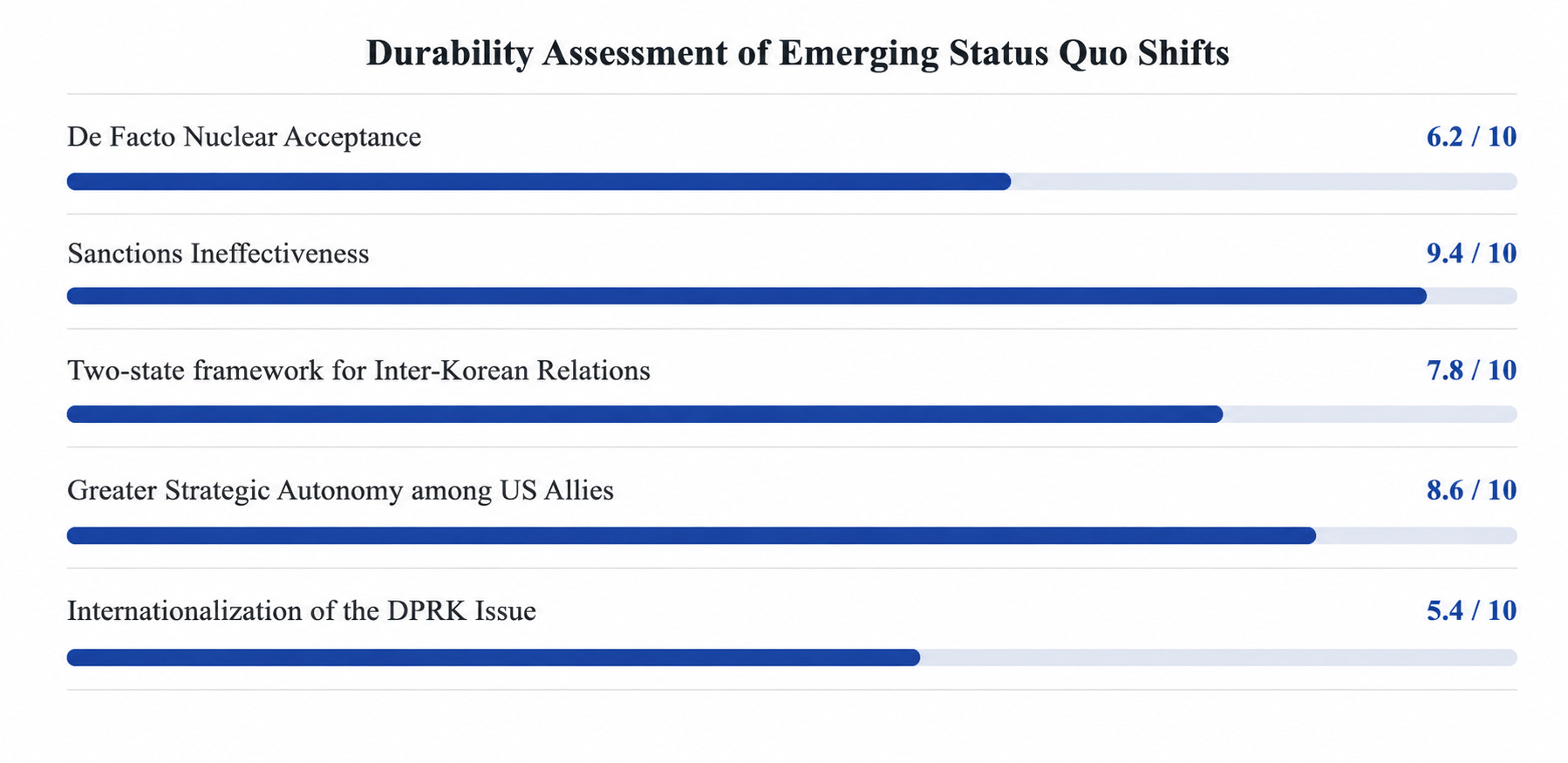
De Facto Nuclear Acceptance: Moderate Durability (6.2/10)
The emerging trend toward de facto acceptance of North Korea’s nuclear status received a more mixed assessment compared to the other shifts. While certain respondents noted declining expectations regarding denuclearization and a reduced emphasis on the issue by both Russia and China, a majority also highlighted the continued formal commitment of the United States, South Korea, and Japan to denuclearization. Particularly, six experts made similar comments concluding that the future trajectory of US policy was the most important variable in determining whether this trend consolidates into a more durable status quo.
Sanctions Ineffectiveness: Very High Durability (9.4/10)
Experts viewed the decline in sanctions as an effective tool of pressure or coercion against North Korea as the most durable shift examined in this research paper. The erosion of great-power consensus within the UN Security Council, combined with deepening Russia-DPRK cooperation, has weakened the enforcement architecture underpinning the sanctions regime. Experts noted that, even if political conditions improve, rebuilding the level of international coordination that existed in previous decades is likely to prove difficult. As a result, sanctions are expected to remain a less effective constraint on North Korea’s strategic development than they once were.
Two-state framework for Inter-Korean Relations: High Durability (7.8/10)
The shift toward a coexistence or two-state framework for inter-Korean relations was also viewed as relatively durable. North Korea’s abandonment of reunification as a state objective, combined with the prolonged breakdown in inter-Korean engagement, suggests that a return to previous assumptions regarding reconciliation is unlikely in the near term.
Several experts noted, however, that the current Lee government’s coexistence plan may be reversed if the following administration has a conservative leaning. Under these conditions, they argued, ROK policy toward the DPRK would likely return to one centered around unification.
Greater Strategic Autonomy among US Allies: High Durability (8.6/10)
Experts assessed the trend toward greater strategic autonomy in Seoul and Tokyo as likely to persist. Although the US alliance system remains central to both countries’ security strategies, concerns regarding long-term strategic uncertainty and North Korea’s advancing military capabilities have encouraged greater investment in indigenous defense capabilities. Even if confidence in US commitments strengthens, many of the capability and policy changes currently underway are likely to endure.
Internationalization of the DPRK Issue: Moderate Durability (5.4/10)
Experts viewed the internationalization of the North Korea issue as the least durable of the shifts examined. While Pyongyang’s support for Russia’s war effort and its growing alignment with Moscow and Beijing have expanded the geographic and strategic scope of the DPRK issue, much of this trend remains dependent on broader geopolitical developments. Changes in the trajectory of the Ukraine conflict, Russia-DPRK cooperation, or regional great-power competition could significantly alter the extent to which North Korea remains embedded in wider international security concerns.
Regarding a Taiwan contingency, three experts assessed that North Korea would still likely remain primarily a regional threat. In their view, direct North Korean involvement would not align with China’s strategic interests. Two experts made specific points about Beijing preferring a strategy of independent victory, as broadening the conflict to involve additional actors would likely extend the duration of military operations and generate greater regional instability—both of which China would have strong incentives to avoid. Two experts notably disagreed, however, with one stating that North Korean military support for a Chinese invasion of Taiwan would be “a disaster” and the other arguing that “given North Korean soldiers being sent to the warfront in Russia, it’s difficult to imagine Kim wouldn’t at least do that much for his friend Xi.”
Overall, however, most experts found that the North Korea issue would still remain mostly a regional problem in the near future.
The following chart provides a visual representation of the durability of each shift in accordance with the responses received to the survey.
IV. Conclusion
The developments examined in this research paper point not to a single new status quo, but to a broader transformation of the strategic environment surrounding the Korean Peninsula. While these shifts vary in their likely durability, collectively they suggest that many of the assumptions underpinning policy toward North Korea since the end of the Cold War are becoming increasingly difficult to sustain.
The institutions, alliances, and formal policy objectives that have long defined approaches to the DPRK remain in place, but the conditions under which they operate have changed significantly, creating a widening gap between established policy frameworks and strategic realities.
The expert survey suggests that not all of these shifts are equally likely to endure. Respondents viewed the erosion of sanctions effectiveness as the most durable emerging status quo, followed by the growing pursuit of strategic autonomy by US allies and the evolution of inter-Korean relations toward one centered around a two-state framework. By contrast, the internationalization of the DPRK issue and the gradual emergence of de facto acceptance of North Korea’s nuclear status were viewed as more contingent on future geopolitical developments.
For Pyongyang, this evolving environment has expanded opportunities rather than constraints. Deepening ties with Russia, reduced dependence on South Korea, and the fragmentation of major-power consensus have increased North Korea’s diplomatic leverage and strategic room for maneuver while diminishing many of the sources of pressure that previously shaped its behavior.
For the United States, South Korea, Japan, and other stakeholders, the principal challenge is to ensure that policy evolves alongside the changing strategic environment. While the pursuit of regional stability and effective deterrence will remain central objectives, some longstanding policy goals and instruments may become progressively more difficult to sustain under current strategic conditions
Future approaches to the DPRK will therefore need to place greater emphasis on adapting diplomatic, military, and economic strategies to contemporary realities rather than relying on frameworks shaped by a markedly different geopolitical context.
A thoughtful and insightful editorial.